

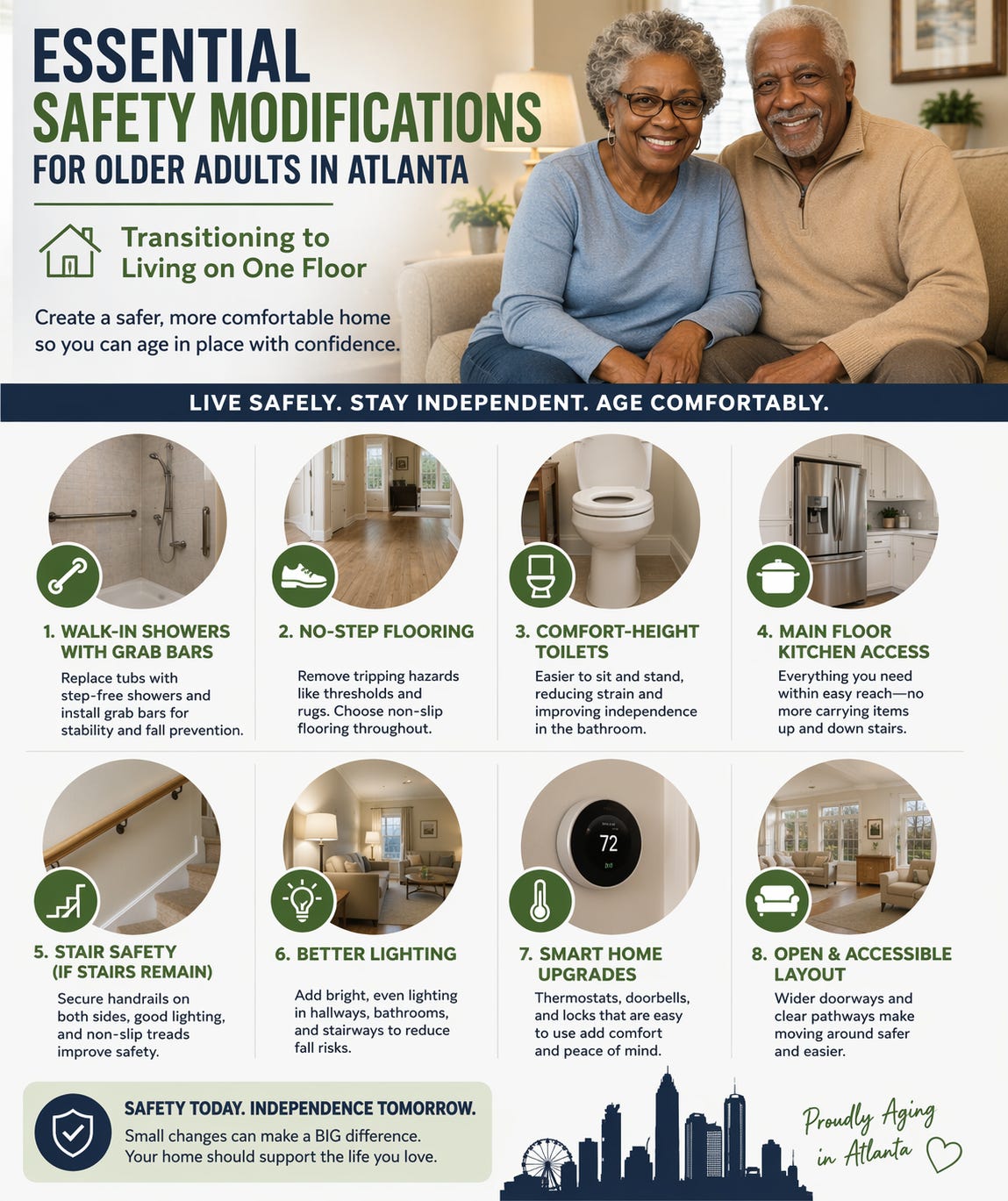
Across Fulton County’s historic neighborhoods — from the craftsman bungalows of Grant Park to the split-level colonials of Sandy Springs — tens of thousands of older adults face the same pivotal moment: the stairs that have always connected their daily life are becoming a liability rather than a convenience. The decision to transition to main-floor living is one of the most important a senior homeowner can make. But making that transition safely requires more than just moving the bedroom downstairs.
Safety modifications for older adults in Atlanta carry a dual purpose that general home safety advice rarely acknowledges. They are simultaneously a health intervention and a real estate investment. In Atlanta’s appreciating market, a thoughtfully modified main-floor living space extends a home’s usability for 10 to 20 or more additional years — protecting both the person who lives there and the asset that often represents their primary source of family wealth.
Fulton County’s housing stock spans pre-1930 craftsman homes in Grant Park and Vine City, 1960s and 1980s split-levels in Sandy Springs and Dunwoody, and newer construction in South Fulton. Each presents distinct modification challenges: narrow original doorways in historic homes, multi-level entries in split-levels, and original hardwood flooring throughout that Georgia’s humidity cycles make increasingly hazardous over time. This guide addresses all of it with specific, actionable guidance and local resources.
The Fulton County Reality — Why Your Atlanta Home Needs This Transition Now
Understanding why this transition matters — and why it matters specifically in Atlanta — is the foundation for making the right modifications in the right order.
The Cost of a Fall vs. the Cost of Prevention
Falls are the leading cause of injury-related death among Americans over 65. In Fulton County, where the senior population is growing rapidly, the medical cost of a fall-related injury averages $30,000 to $50,000 in emergency care, rehabilitation, and follow-up treatment. A single hip fracture can trigger a cascade: hospital stay, rehabilitation facility, long-term care, and frequently the permanent inability to return to the home. The cost of comprehensive safety modifications — typically $15,000 to $45,000 for a full main-floor transition in Atlanta — is a fraction of one preventable event.
For the full federal framework on fall prevention and evidence-based home safety interventions, the National Institute on Aging fall prevention and home safety guide for older adults provides room-by-room guidance that complements Atlanta-specific modifications.
Atlanta’s Housing Stock and Its Specific Challenges
Fulton County’s housing diversity creates a wide range of modification challenges:
• Pre-1950 craftsman and bungalow homes (Grant Park, West End, Inman Park, Kirkwood): original doorways as narrow as 28 inches, high-gloss original hardwood throughout, plaster walls that require different grab bar anchoring than standard drywall, and elevated front entry steps with no ramp.
• 1960s–1980s split-levels and two-story colonials (Sandy Springs, Roswell, Alpharetta, Dunwoody): all bedrooms on a separate level from the kitchen and main living area, often with no bathroom on the main floor, and entry configurations that require stepping up from garage to home interior.
• 1990s–2000s suburban construction (South Fulton, College Park, East Point): generally better door widths but often with carpet-to-tile transitions at bathroom and kitchen entries that create hidden trip hazards.
Why This Transition Protects Your Fulton County Legacy
For Atlanta seniors who own their home outright — particularly in historically Black neighborhoods like Cascade Heights, Vine City, Pittsburgh, and Southwest Atlanta where properties have been in families for generations — making the home safe for continued occupancy is also an act of wealth preservation. A senior who remains in the home safely preserves the asset from forced sale, deferred maintenance accumulation, and the equity-depleting outcomes associated with a health crisis. A properly modified main-floor living space also commands a broader buyer pool when the time comes to sell: accessibility-conscious buyers, seniors, and families with aging parents all represent growing market segments in Metro Atlanta.
The heirs’ property parallel: Many Atlanta seniors in historic neighborhoods own properties with heirs’ property title complications. Making safety modifications before resolving title issues may limit program eligibility. Addressing title clarity alongside modification planning protects the full benefit of both investments.
Foundation of Movement — Non-Slip Flooring and Clear Pathways
The floor beneath your feet is the most fundamental safety system in your home. In Atlanta’s climate and in the city’s diverse housing stock, it is also one of the most neglected.
Georgia Humidity and What It Does to Atlanta Floors
Atlanta’s climate is characterized by significant humidity variation — summer humidity levels exceeding 80% followed by drier winter periods. Original hardwood in pre-1950 Atlanta homes expands in summer humidity and contracts in winter dryness, creating subtle surface variations and inconsistent traction conditions that change throughout the year. The high-gloss finish standard on original Atlanta hardwood creates genuinely dangerous walking surfaces for older adults in socks or soft-soled shoes — especially in morning conditions when the floor temperature is lower than ambient air temperature and condensation affects traction.
Area rugs placed over hardwood — common in Atlanta homes for both aesthetics and comfort — represent a compound trip hazard: they curl at edges, bunch under furniture, and slip on the smooth hardwood beneath. This is one of the most dangerous and most easily preventable fall risks in Atlanta’s historic housing stock.
High-Traction Flooring Choices for Atlanta Homes
• Luxury Vinyl Plank (LVP) with matte, textured finish: The most popular aging-in-place flooring choice in Atlanta. Handles Georgia’s humidity variation better than hardwood, offers genuine and consistent traction, and is available in styles that complement both historic and modern Atlanta homes.
• Slip-resistant ceramic or porcelain tile: Required for wet areas including bathrooms, kitchen entry, and laundry. Look for a coefficient of friction (COF) rating of 0.60 or higher for appropriate wet-surface safety.
• Low-pile carpet: For bedroom and living areas. Offers superior traction and cushioning — important both for walking safety and for fall impact mitigation if a fall occurs.
• Area rug protocol: Remove all standard area rugs or replace them with certified non-slip versions with gripper backing and beveled edges. Never place standard area rugs over hardwood in a one-floor transition layout.
Identifying and Eliminating Trip Hazards in Transition Areas
The kitchen-to-living-room transition is among the highest-risk zones in Atlanta homes. Flooring materials typically change here — tile to hardwood or hardwood to carpet — and the elevation difference is often subtle enough to catch a toe without being consciously noticed. Raised transition strips should be replaced with flush or ramped transitions that eliminate the step-over requirement entirely. Electrical cords, phone chargers, and extension cords crossing walking paths should be rerouted through wall channels or along baseboards with cord management strips.
Strategic Furniture Layouts for Walkers and Mobility Aids
A clear walking path of 36 inches minimum width is the standard for walker users; 42 to 48 inches is preferable for wheelchair and rollator users. Furniture groupings should create natural pathways rather than obstacles. The three paths to clear first: bedroom to bathroom, kitchen to main seating area, and front door to main living space. Coffee tables, side tables, and decorative items at ankle and shin height are among the most common fall contributors — evaluate every piece of furniture in the one-floor living space from a movement standpoint, not an aesthetic one.
Securing High-Risk Zones — Reinforced Grab Bars and Ergonomic Hardware
Grab bars and ergonomic hardware are the modifications most homeowners delay and most wish they had installed sooner. In Atlanta’s market, they are also the modifications that most visibly signal a quality, safety-conscious renovation to future buyers.
Expert Grab Bar Placement in Atlanta Homes
The bathroom is statistically the most dangerous room in the home for older adults. A properly equipped bathroom with correctly placed grab bars transforms it from the highest-risk space in the home to one of the safest. Standard placement guidelines for Atlanta bathroom configurations:
• Beside the toilet: A 42-inch horizontal grab bar on the side wall, positioned 6 to 8 inches from the front of the toilet at 33 to 36 inches from the floor. This supports sitting and standing transitions, which are among the highest fall-risk movements of the day.
• Shower entry: A vertical grab bar at the shower entry point to assist entering and exiting the shower enclosure — the moment of highest fall risk in most bathroom routines.
• Shower interior: A horizontal bar on the back wall at 33 to 36 inches for stability during bathing.
• Hallway bars: Often overlooked but critical for homes with long corridors. A continuous bar along the wall from the primary bedroom to the bathroom provides support for the most common nighttime navigation path.
Contemporary grab bars are available in brushed nickel, oil-rubbed bronze, matte black, and other finishes that complement Atlanta homes’ interior styles. The institutional appearance of hospital-style grab bars is not the standard anymore — well-selected grab bars blend seamlessly with bathroom aesthetics in modern and historic Atlanta homes alike.
Professional-Grade Wall Anchoring Is Non-Negotiable
A grab bar that is not anchored into wall studs or with appropriate blocking will fail under load — and a grab bar that fails during a slip is more dangerous than no grab bar at all. This is the modification where the difference between professional installation and DIY creates the largest risk gap.
Most Atlanta bathroom walls are standard drywall construction with studs typically 16 inches on center — which may not align with ideal grab bar placement. Professional installation involves locating studs, installing blocking where needed, using stainless steel hardware rated for 250 pounds or more, and verifying load capacity after installation. In Atlanta’s older homes with original plaster walls, different anchoring approaches are required — always use a contractor familiar with both the specific wall construction type and the ANSI A117.1 load requirements for grab bars.
Transitioning to Ergonomic Hardware Throughout
Arthritis is the most common chronic condition in Americans over 65. Round door knobs require grip strength and wrist rotation that are significantly compromised by even moderate arthritis. Lever-style door handles require only a downward push with a closed fist. This modification applies to every interior door on the main level: bedroom, bathroom, laundry, and all closets. Lever handles are available in every style and finish available in round knobs — this modification improves function without any visible concession to accessibility.
Apply the same ergonomic principle throughout: rocker-style light switches replacing toggle switches, D-ring cabinet pulls replacing small knobs, and touch-activated or motion-sensing faucets in the kitchen and bathroom for the most advanced implementations.
Atlanta program resource: Rebuilding Together Atlanta installs grab bars, safety hardware, and accessibility modifications at no cost for qualifying low-income senior homeowners across Metro Atlanta. Their services specifically include professional-grade anchoring in a range of Atlanta wall construction types. Contact them before paying out-of-pocket for this modification.
Eliminating Hazards Through Advanced Lighting and Doorway Expansion
Visibility and access are the two modifications most commonly underprioritized in Atlanta home safety planning. Both are correctable with thoughtful, targeted investment.
Upgrading to High-Lumen LED Systems
Vision changes are a normal part of aging. Most adults over 65 need significantly more light to see clearly than they did at 40 — and Atlanta’s historic homes were designed with lighting standards from the 1920s through the 1980s that are dramatically under-powered by current standards. The practical result: shadows at foot level that hide trip hazards, dimly lit kitchens where countertop spills are missed, and bathroom vanity lighting that creates dangerous visibility gaps.
Replace all primary living space fixtures with high-lumen LED bulbs in the 800 to 1,600 lumen range. Add under-cabinet lighting in kitchen work areas. In hallways and corridors, supplement overhead lighting with wall sconces or floor-level path lighting to eliminate the shadow zones that overhead fixtures create at foot level. For color temperature: warm white (2700K to 3000K) for living spaces; cool white (4000K) in kitchen and bathroom task areas where contrast and visibility matter most.
Motion-Activated Path Lighting for Safer Nighttime Navigation
Nighttime bathroom trips are one of the primary fall scenarios for older adults — the combination of grogginess, darkness, and the requirement to navigate a familiar but visually unconfirmed path creates significant risk. Motion-activated LED nightlights installed in electrical outlets along the path from the primary bedroom to the bathroom provide automatic illumination without fumbling for switches. Under-bed motion-activated lighting strips that activate when a foot touches the floor eliminate the dark-bedroom transition entirely.
Smart lighting systems (Lutron, Philips Hue) allow scheduled automatic illumination of key pathways during typical nighttime hours. For Atlanta homeowners specifically: Metro Atlanta experiences regular storm-related power outages from spring through fall. Battery-backup nightlights ensure pathway lighting remains functional during outages — precisely the conditions when a dark, unfamiliar path is most dangerous.
The CDC fall prevention resources and home safety guidelines for older adults provide evidence-based guidance on lighting levels, recommended lumen output, and the specific visual changes of aging that home lighting should address.
Widening Key Door Frames Without Damaging Historic Trim
Standard interior doorways in Atlanta homes are typically 28 to 32 inches clear — below the ADA minimum of 32 inches and often incompatible with standard walkers (which require 24 inches minimum) and rollators. The doorways that most require addressing for main-floor living: primary bedroom entry, bathroom entry, and the main path from sleeping space to kitchen.
For Atlanta’s older homes in Grant Park, Inman Park, West End, and similar historic neighborhoods — where original craftsman door trim and casing has significant aesthetic and preservation value — there are two approaches that avoid destructive widening:
• Offset hinges: Adding offset (swing-clear) hinges to an existing door adds 1.5 to 2 inches of clear width without any structural modification and without touching the trim. This is the least invasive solution and works for many walker users.
• Surgical framing expansion: Where more width is needed (typically for wheelchair access), an experienced contractor can expand the framing while preserving the room-facing trim profile. Cost in Atlanta: $800 to $2,000 per doorway for standard drywall; higher for plaster walls.
• Pocket door conversion: Where neither approach is feasible, replacing a swinging door with a pocket door eliminates the swing arc entirely and adds 3 to 4 inches of effective passage width.
Long-Term Independence — Protecting Your Fulton County Legacy
The final dimension of any Atlanta senior home modification project is the one that extends farthest into the future: how these changes protect the property, the family, and the independence that decades of homeownership has built.
How These Modifications Increase Market Value and Usability
Accessibility modifications are no longer a liability in Atlanta’s real estate market. They are increasingly recognized as value-adding features by a growing and demographically significant buyer pool. Metro Atlanta’s aging population means the number of buyers specifically seeking accessible or adaptable homes grows every year. A main-floor suite with accessible bathroom, lever hardware, reinforced grab bars, and wide doorways appeals to senior buyers, buyers with aging parents, buyers with disabilities, and any buyer who values thoughtful quality renovation.
The cost of comprehensive modifications is typically $15,000 to $45,000 for a full main-floor transition in Atlanta. A well-executed modification project commonly returns 80 to 120 percent of that cost in increased sale price, faster time to sale, and reduced negotiating leverage for buyers who would otherwise request concessions for accessibility concerns.
Local Atlanta Resources That Can Reduce Your Out-of-Pocket Cost
• Atlanta Habitat for Humanity — Repair with Kindness: Up to $20,000 in critical repairs including accessibility modifications for qualifying seniors age 55+. Applications through atlantahabitat.org.
• Rebuilding Together Atlanta: Free grab bar installation, ramp construction, safety lighting, and trip hazard removal for qualifying low-income senior homeowners across Metro Atlanta. The Rebuilding Together Atlanta free safety modifications for senior homeowners program accepts applications year-round.
• Atlanta Regional Commission CARE Line: (404) 463-3333. Connects seniors and families with local contractors, programs, and home modification resources across Fulton County.
• AARP HomeFit Program: The AARP HomeFit guide for making your Atlanta home accessible and safe provides a free, detailed assessment framework that Atlanta homeowners can use to prioritize modifications by impact before spending anything.
The Final Checklist for a Worry-Free Main-Level Transition
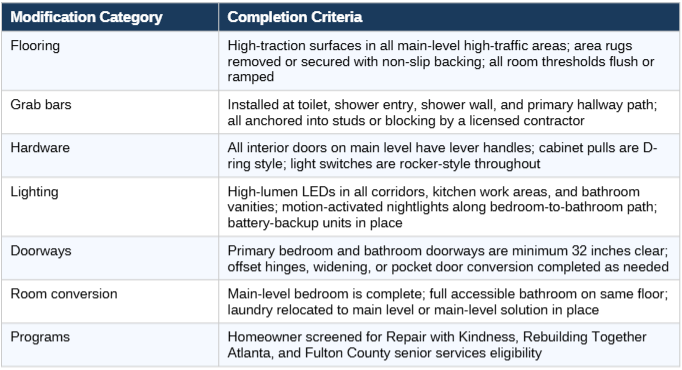
Connecting with the right contractor matters: not every Atlanta contractor is equipped for aging-in-place work. Certified Aging in Place Specialists (CAPS) — certified through the National Association of Home Builders — have specific training in accessibility, universal design, and senior-specific modification. Ask for CAPS certification when soliciting bids for any of the modifications in this guide.
Final Thoughts: Small Changes, Lasting Protection
The modifications in this guide are not cosmetic. They are structural decisions that determine whether an Atlanta senior homeowner spends the next decade living independently in the home they have built their life around — or spending it in a care facility recovering from a preventable accident. The financial case is clear: the cost of comprehensive modifications is a fraction of the cost of a single serious fall. The property value case is also clear: a thoughtfully modified Atlanta home is more marketable, more insurable, and more livable than one that forces the next owner to face the same modification decisions from scratch.
In Fulton County’s market, where generational homeownership is both financially significant and culturally meaningful, the decision to modify is also a decision to preserve. These are the homes that matter most. Protect them.
Ready to Make Your Atlanta Home Safe for the Long Term? ATL Home Help Solutions Can Help.
Making your Atlanta home safe for one-floor living is one of the most important decisions you’ll make for your health, your independence, and your family’s legacy. Whether you need help evaluating what your Fulton County property needs, connecting with the right contractors and programs, or understanding what these modifications mean for your home’s value — ATL Home Help Solutions is here. I’m Gerald Harris. I work with Atlanta and Fulton County senior homeowners and their families to navigate exactly these kinds of decisions — from modification planning to understanding when a transition to a different property makes more sense.
No pressure. No guesswork. Just honest local guidance.
📞 Call or Text: 404-913-7086 📧 Email: gerald@atlhomehelp.com
Visit ATL Home Help Solutions — Contact Gerald Harris — No pressure. No judgment. Just honest local guidance.