


Quick Answer: An unpaid Fulton County water bill is not just a utility problem — it is a property problem. Under Georgia law, Fulton County has a lien by operation of law on any property with a delinquent water account, and that lien can be recorded in Superior Court, cloud your title, and escalate toward foreclosure. Addressing a high or unpaid Fulton County water bill immediately — before it attaches to your property record — is one of the most important steps a Fulton County homeowner can take to protect their investment.
Most homeowners in Fulton County think of a high water bill as an inconvenience. They call it in, dispute the meter reading, and put it on the list of things to sort out later. As a real estate consultant who works with property owners across Metro Atlanta every day, I want to be direct with you: that approach is one of the most common and most costly mistakes I see.
A Fulton County water bill that goes unpaid long enough does not stay in the utility department. It follows your property. Under Georgia law, when a water bill becomes delinquent, the county holds a lien by operation of law — meaning a legal claim attaches to your property automatically, without any additional action required from the county. Once recorded in Fulton County Superior Court, that lien clouds your title, can prevent a sale or refinance, and in the most serious cases can be transferred to private investors and ultimately lead to a courthouse steps foreclosure.
This is not a scare tactic. It is the legal reality that Georgia’s water service agreements clearly state: if your bill is delinquent, the county has a lien by operation of law and may record a lien against the property to secure payment.
This guide walks Fulton County homeowners through what drives unusually high water bills, how to dispute and resolve them, what the escalation path looks like when bills go unpaid, what your options are at every stage, and — at the end — which Atlanta-area attorneys are specifically equipped to help when a lien has already been recorded. The earlier you act, the more options you have and the less it costs.
Why Your Fulton County Water Bill Is So High — And How to Find Out for Sure
Before addressing how a water bill escalates into a property lien, it’s worth understanding why so many Fulton County homeowners are seeing bills that seem unreasonably high in the first place. In working with Atlanta-area property owners, five root causes account for the vast majority of billing disputes.
1. Silent Leaks and Running Toilets
This is the most common driver of abnormally high water consumption in Atlanta homes — and also the most invisible. A running toilet can waste between 200 and 7,000 gallons of water per day without making any audible sound. A slow slab leak under a concrete foundation can run for months before any visible damage appears. In older homes in neighborhoods like East Point, College Park, Vine City, and Mechanicsville — where plumbing infrastructure is aging — silent leaks are far more common than homeowners realize.
2. Meter Reading Errors
Fulton County’s water meters are read automatically in most service areas, but automated systems can produce incorrect readings when meters are damaged, obstructed, or malfunctioning. If your Fulton County water bill has spiked dramatically in a single billing cycle with no change in usage habits, a meter reading error is one of the first things to investigate.
3. Billing to the Wrong Account or Property
In dense urban areas and multi-unit properties across Atlanta — particularly in areas like Decatur, Kirkwood, and Southwest Atlanta where lot lines are close and addresses can be similar — billing errors that assign consumption to the wrong account do occur. If you own multiple properties, this risk increases significantly.
4. Seasonal and Weather-Related Spikes
Atlanta’s hot summers drive significant increases in outdoor water use — irrigation systems, car washing, and pool maintenance all add to consumption during June through August. A bill that spikes in summer may reflect real usage. But if the spike continues into fall or winter with no change in activity, it is time to investigate for a leak.
5. Rate Increases
Fulton County’s water and sewer rates have increased in recent years as the county has invested in infrastructure upgrades and compliance with state and federal water quality requirements. A higher bill may simply reflect a rate change rather than a consumption problem. Check the Fulton County Finance Department’s water billing schedule to compare current rates with prior periods.
If you have received a Fulton County water bill that seems dramatically higher than your typical usage, do not ignore it. Call the Fulton County Finance Department Water and Sewer Billing Division at 404-612-6830 immediately to request a meter re-read and begin a formal dispute while the bill is still in the current billing cycle.
How to Dispute a High Fulton County Water Bill and Protect Your Property
Disputing a Fulton County water bill requires a methodical approach. Homeowners lose disputes they should have won simply because they did not document their case properly or did not follow the county’s process in the correct order. Here is the step-by-step approach that produces the best outcomes.
1. Request a meter re-read: Your first call should be to the Fulton County Finance Department, Water and Sewer Billing Division at 404-612-6830. Request a physical meter re-read by a county technician. This is free and is the starting point for any billing dispute. You can also manage your account and view billing history through the Fulton County water billing portal.
2. Conduct a leak inspection: Turn off all water fixtures in your home. Locate your water meter and observe whether it is still moving. Even small movement indicates water is flowing somewhere — which means a leak exists. Document this with photos and a written note of the date and time. If a leak is confirmed, get a licensed plumber to inspect and provide a written repair estimate or invoice.
3. Submit a formal billing dispute in writing: Do not rely on a phone conversation alone. Submit a written dispute that includes your account number, the billing period in question, the specific amount you are disputing, and all supporting documentation — meter re-read results, plumber’s report, leak repair receipts, and photographs. Keep a copy of everything you submit.
4. Request a leak adjustment: Fulton County’s billing policies include provisions for adjustments when a documented leak has been repaired. You must show that the leak has been fixed, provide the repair documentation, and demonstrate that the excess consumption was attributable to the leak. This adjustment is not automatic — you must specifically request it.
5. Escalate to a supervisor if needed: If the initial dispute is not resolved, request escalation to a billing supervisor or manager. Document every interaction — date, time, representative name, and the substance of the conversation. If escalation within the billing division is unsuccessful, the Fulton County Finance Department provides a formal appeals process.
Do not wait for a dispute to be fully resolved before making any payment. If there is an undisputed portion of the bill, pay it. Paying the undisputed amount while formally contesting the balance demonstrates good faith and can prevent the account from moving into delinquency status while the dispute is pending.
What Happens When a Fulton County Water Bill Goes Unpaid: The Lien Escalation Path
This is the section most homeowners never read until it is too late. Understanding the escalation path from an unpaid Fulton County water bill to a recorded property lien — and beyond — is essential for every Atlanta-area property owner.
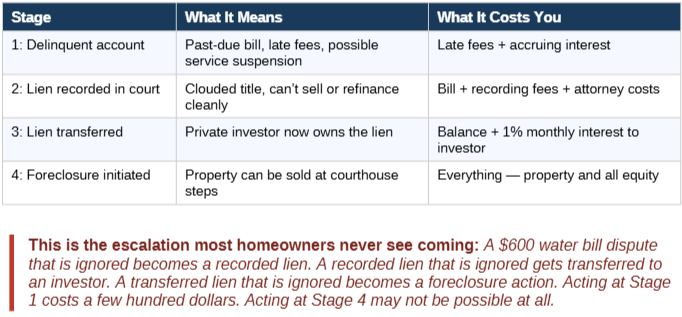
Stage 1: Delinquent Account
When a Fulton County water bill is not paid by its due date, the account becomes delinquent. Late fees and interest begin accruing. The county will send notices and may suspend water service to the property. Service suspension is serious for occupied properties but also relevant for vacant or rental properties where the owner may not be immediately aware.
Stage 2: Lien by Operation of Law
Under Georgia law and Fulton County’s water service agreement, a lien attaches to the property automatically when the water bill becomes delinquent. This is called a lien by operation of law — it does not require a court order or a separate filing to exist. The county may then record this lien in Fulton County Superior Court, making it a matter of public record that appears in all title searches. Once recorded, the property cannot be sold or refinanced with clean title until the lien is paid and formally released.
Stage 3: Lien Transfer to a Private Investor
Georgia law allows the county to transfer recorded liens to private investors. Once transferred, the county is no longer involved in collection. The private lien holder has the right to pursue collection independently, and interest continues to accrue at 1% per month on the unpaid balance. This is the point where a manageable utility bill can begin compounding in a way that feels out of control.
Stage 4: Foreclosure
When a transferred lien is not satisfied, Georgia law gives the lien purchaser the right to pursue a Sheriff’s levy and foreclosure on the property. The Sheriff conducts this foreclosure sale on the courthouse steps on the first Tuesday of the month — the same venue and process as a mortgage foreclosure. For a more detailed explanation of the full escalation path, the Fulton County Tax Commissioner’s lien transfer and foreclosure overview provides authoritative plain-language guidance.
Stage
What It Means
What It Costs You
1: Delinquent account
Past-due bill, late fees, possible service suspension
Late fees + accruing interest
2: Lien recorded in court
Clouded title, can’t sell or refinance cleanly
Bill + recording fees + attorney costs
3: Lien transferred
Private investor now owns the lien
Balance + 1% monthly interest to investor
4: Foreclosure initiated
Property can be sold at courthouse steps
Everything — property and all equity
This is the escalation most homeowners never see coming: A $600 water bill dispute that is ignored becomes a recorded lien. A recorded lien that is ignored gets transferred to an investor. A transferred lien that is ignored becomes a foreclosure action. Acting at Stage 1 costs a few hundred dollars. Acting at Stage 4 may not be possible at all.
Your Options If You’re Behind on Your Fulton County Water Bill or Facing a Lien
If your Fulton County water bill is past due, disputed, or has already escalated to a recorded lien, you have specific options at each stage. Here is how I counsel property owners who come to me at different points in this process.
If You’re Behind but No Lien Has Been Recorded
This is the most straightforward situation to resolve. Contact the Water and Sewer Billing Division at 404-612-6830, confirm your balance including any fees, and pay the full amount or request a structured payment arrangement. The county does offer payment plans in appropriate circumstances — ask specifically about installment options when you call. Paying before a lien is recorded keeps your title clean and avoids all downstream complications. You can make a payment directly through the Fulton County water bill payment portal at fultoncountyga.gov or by calling 404-612-6830.
If a Lien Has Already Been Recorded
A recorded lien is more serious but still manageable if you act promptly. The full payoff will include the original unpaid balance, accrued interest, the lien recording fee, and potentially attorney fees. Contact the Water and Sewer Billing Division to get the current payoff figure and confirm it includes everything required for a formal lien release. Pay by certified funds and request a written lien release document to file with the Fulton County Superior Court Clerk. Retain that release document permanently — you will need it when you sell or refinance. The Fulton County Tax Commissioner’s property records portal can confirm current lien status on your property.
If the Lien Has Been Transferred to a Private Investor
Once a lien is transferred, the Fulton County water billing office is no longer the point of contact for payoff. You will need to identify the current lien holder through Fulton County Superior Court Clerk’s records and contact them directly to negotiate payoff and lien release. Interest continues accruing at 1% per month. Consider consulting a Georgia real estate attorney at this stage to ensure payoff and release are handled correctly.
If a Foreclosure Action Has Been Initiated
This is the most urgent scenario. If you have received any notice of a Sheriff’s levy or scheduled foreclosure sale related to a water or utility lien, treat it with the same urgency as a mortgage foreclosure. Contact the Georgia Legal Aid property rights and housing resource for free legal guidance, or consult a Georgia real estate attorney immediately. If you have equity in the property, a voluntary as-is sale may be the most effective way to protect that equity before the courthouse steps sale eliminates it entirely.
Check Your Property Tax Status in Parallel
A high water bill and a delinquent water lien often appear alongside other financial pressures. Take this opportunity to verify your property tax status as well through the Fulton County Tax Commissioner’s property search portal. Seniors age 62 and older may be eligible for property tax exemptions that reduce annual liability by $1,000 to $2,000 or more — relief that makes every other financial obligation more manageable.
RESOURCE SECTION: Attorneys Who Can Help With Fulton County Water Bill Liens
As a real estate consultant, one of the most consistent pieces of advice I give homeowners dealing with a recorded lien is this: once a lien has been filed in Fulton County Superior Court or transferred to a private investor, you are no longer just dealing with a billing department. You are dealing with a legal matter that requires a legal professional.
The three attorneys and firms listed below each handle property lien disputes, title issues, and real estate law in Fulton County and Metro Atlanta. They have been verified as active through their official websites and professional profiles. Always confirm contact information directly before scheduling a consultation.
3 Verified Atlanta-Area Attorneys for Water Bill Lien and Property Lien Issues
1. Wiggam Law — Jason Wiggam, Founder
Tax Law Firm | Atlanta, Georgia
📍 Address: 1275 Peachtree St NE, Suite 500, Atlanta, GA 30309
📞 Phone: (404) 609-1300
🌐 Website: wiggamlaw.com
⚖️ Practice Focus: Tax liens (IRS and state), lien resolution, Georgia Department of Revenue disputes, collection actions, installment agreements, offers in compromise
✅ Best For: Homeowners dealing with tax-based liens recorded against their property, lien removal and resolution, situations where a water or utility lien has intersected with a state tax execution
💡 Note: One of Atlanta’s most established tax lien resolution firms. Founded by Jason Wiggam specifically to handle cases other firms won’t take. AV-rated by Martindale-Hubbell. Free intake consultation available through their website. Particularly well-suited for situations where a utility lien and a state tax lien appear on the same property simultaneously.
2. The Libby Law Firm (Duncan H. Adams, Attorney)
Real Estate & Business Law | Atlanta, Georgia
📍 Address: Buckhead (Atlanta), Midtown Atlanta, and Marietta offices
📞 Phone: (404) 445-7771
🌐 Website: duncanadamslaw.com
⚖️ Practice Focus: Real estate litigation, property lien disputes, quiet title actions, housing code violations in Atlanta and Fulton County, landlord-tenant disputes, real estate contract disputes
✅ Best For: Homeowners facing a recorded lien who need to dispute the lien, clear title before a sale, or pursue quiet title relief in Fulton County Superior Court
💡 Note: A well-established Atlanta real estate and business law firm with three Metro Atlanta offices. Duncan Adams leads the real estate practice with specific experience in Fulton County property disputes and lien-related title issues. Represents homeowners in Fulton, Cobb, Clayton, DeKalb, and Gwinnett counties. Best first call for homeowners who need to challenge a lien’s validity or clear title before selling.
3. Gabrielle E. Espy — Hudson Lambert Parrott Walker, LLC
Construction, Real Estate & Lien Law | Atlanta, Georgia
📍 Address: Atlanta, Georgia (Fulton County service area)
📞 Phone: (404) 554-8181
🌐 Website: hlpwlaw.com
⚖️ Practice Focus: Real estate law, mechanics and materialmen’s liens, property rights, bank and tax foreclosures, title clearing, landlord-tenant disputes, property boundary disputes, creditor rights
✅ Best For: Homeowners who need to dispute the validity of a lien, clear encumbered title, navigate a bank or tax foreclosure related to a property lien, or resolve a title defect before a scheduled sale
💡 Note: A Fulton County-based real estate attorney with specific, documented experience in property lien law, title clearing, and bank and tax foreclosure cases in Metro Atlanta. Has argued over 100 cases before state and federal judges as lead counsel. Raised in Decatur, Georgia — genuinely local expertise in Fulton County property law.
When Should You Call an Attorney? A Simple Decision Guide
Many homeowners wait too long before involving a legal professional in a lien dispute. Here is a straightforward framework to know when a call makes sense.
Your Situation
Recommended First Step
Who to Call
High bill, still in dispute stage
Call Fulton County billing: 404-612-6830
No attorney needed yet
Lien recorded in Superior Court
Get payoff; attorney if validity is in question
The Libby Law Firm — (404) 445-7771
Lien transferred to a private investor
Contact lien holder; attorney recommended
The Libby Law Firm or Gabrielle Espy
Lien blocking a sale or refinance
Attorney needed immediately
Gabrielle Espy — (404) 554-8181
Tax lien and water lien on same property
Tax attorney recommended
Wiggam Law — (404) 609-1300
Foreclosure action initiated on utility lien
Attorney required immediately
All three — call today
Free Legal Help for Qualifying Fulton County Homeowners
If retaining a private attorney is not financially feasible right now, the following free and low-cost legal resources serve Fulton County homeowners:
Atlanta Legal Aid Society — Free legal representation for qualifying low-income homeowners in Fulton County facing property liens, foreclosure, or housing instability. Call (404) 524-5811.
Georgia Legal Aid — Free online legal resources and, for qualifying residents, direct legal assistance on property rights, lien disputes, and housing matters. Visit georgialegalaid.org.
Georgia Senior Legal Hotline — For homeowners age 60 and older. Free legal advice on property, housing, and financial matters. Call (404) 389-9992.
State Bar of Georgia Lawyer Referral Service — Connects you with a vetted, licensed Georgia real estate attorney. Call (800) 334-6865 or visit gabar.org.
Always verify attorney contact information and current availability directly before scheduling a consultation. The attorney information in this guide was compiled from publicly available professional sources and is intended as a starting point for your research, not a formal legal referral.
Final Thoughts: A Water Bill Is a Property Issue, Not Just a Utility Issue
As a real estate consultant, the advice I give every Fulton County property owner is the same: treat your water bill with the same seriousness you treat your property tax bill. Both can result in liens against your title. Both can escalate toward foreclosure if ignored. And both are significantly easier and cheaper to resolve at Stage 1 than at Stage 4.
A high Fulton County water bill is often the result of a leak, a meter error, or a billing mistake — all of which are fixable. What is not as easily fixed is the title damage and financial escalation that results from ignoring the problem. Whether you are looking at a $400 dispute or a recorded lien on a property you are trying to sell, the path forward exists — but it requires action now, not later.
Your home is likely your most significant financial asset. Protect it with the same level of attention you would give any other major investment. And if you are not sure where to start — that is exactly what ATL Home Help Solutions is here for.
Have Questions About Your Fulton County Property’s Financial Health?
Whether you’re dealing with a high water bill that’s turned into a lien, navigating delinquent property taxes, or trying to understand what’s attached to your title before selling — I can help. I’m Gerald Harris, founder of ATL Home Help Solutions, and I work with property owners across Fulton County and Metro Atlanta who need honest, clear guidance on exactly these kinds of issues. Before you call an attorney, it helps to understand which stage your lien is in and which professional is the right first call. That conversation is free, and it could save you from an expensive mistake.
Don’t wait until a utility bill becomes a property lien. Reach out today.
📞 Call or Text: 404-913-7086 📧 Email: gerald@atlhomehelp.com
Visit ATL Home Help — Contact Gerald Harris — No pressure. No judgment. Honest local guidance.