


U.S. homeowners hold a record $17 trillion in equity, offering financial opportunities.
Using home equity wisely can prevent foreclosure, pay debts, or fund emergencies during hardship.
Selling your home early is often a safer alternative than taking on additional debt.
U.S. homeowners are sitting on a record $17 trillion in total equity, yet thousands of Atlanta families face foreclosure every year without realizing they may have a financial lifeline right under their roof. Home equity is one of the most powerful tools available to a distressed homeowner, but it is also one of the most misunderstood. Use it wisely and it can help you stay in your home, pay off debt, or exit on your own terms. Misuse it and you could end up deeper in the hole. This guide breaks down what home equity is, how to calculate yours, and what your real options are if you are facing financial hardship in Atlanta.
Table of Contents
A better way to think about home equity when under financial stress
Facing tough decisions? Get help with your home equity options
Key Takeaways
PointDetailsHome equity basicsYour equity equals your home’s value minus what you owe and is a key resource in times of financial stress.Tapping equity optionsEquity loans, HELOCs, and selling are main ways to access funds, but not all options are safe when behind on payments.Risks of more debtTaking new loans in distress may speed up foreclosure—exiting with equity often preserves more future flexibility.Atlanta expert helpLocal guidance ensures you make the best use of your equity without risking your home.
What is home equity and why does it matter?
Home equity is the portion of your home that you actually own. The formula is simple: Equity = Current Home Value – What You Still Owe. If your Atlanta home is worth $280,000 and you owe $180,000 on your mortgage, you have $100,000 in equity. That is real money, and it belongs to you.
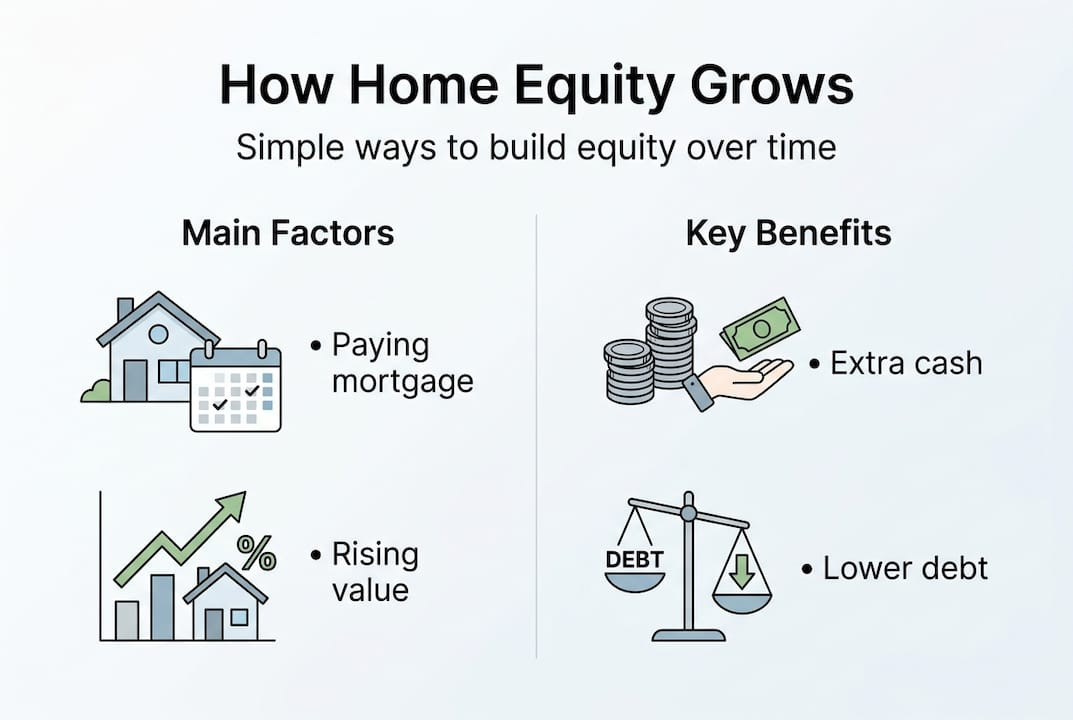
Equity grows in two main ways. First, every mortgage payment you make reduces your loan balance, which increases your equity. Second, when home values rise in your neighborhood, your equity goes up even if you haven’t paid down a single extra dollar. Atlanta’s real estate market has seen steady appreciation over the past decade, which means many homeowners have built more equity than they realize.
Why does this matter when you are in financial distress? Because equity gives you choices. Here is what equity can help you do:
Sell your home and walk away with cash to pay off debts and start fresh
Borrow against your home to cover urgent expenses or catch up on missed payments
Avoid foreclosure by using equity to negotiate with lenders or pay off arrears
Access programs that require equity as a qualification for assistance
According to 2026 equity data, U.S. homeowners now hold a record $17 trillion in total equity, with $11 trillion considered tappable at 80% loan-to-value or lower. That is an enormous amount of untapped potential for homeowners who know how to use it.
If you are already dealing with foreclosure stress, understanding your equity position is the first step toward finding a real path forward.
How to calculate your home equity and loan-to-value ratio
Knowing your equity is one thing. Knowing how lenders view it is another. Before you can explore borrowing options, you need to understand your loan-to-value ratio, or LTV. This number tells lenders how much of your home’s value is already tied up in debt.
Here is how to calculate both in four steps:
Find your home’s current market value. Use a recent appraisal, a licensed real estate agent’s estimate, or an online tool like Zillow as a starting point. Keep in mind that online estimates are not always accurate, so a professional opinion is more reliable.
Find your total loan balance. Check your most recent mortgage statement. If you have a second mortgage or home equity line of credit already open, add those balances too. Many homeowners forget about second liens, which is a costly mistake.
Calculate your equity. Subtract your total loan balance from your home’s current value. The result is your equity.
Calculate your LTV. Divide your loan balance by your home’s value and multiply by 100. For example: $180,000 ÷ $280,000 = 0.64, or 64% LTV.
Pro Tip: Your LTV directly affects what options are available to you. Most lenders require your LTV to stay at or below 80% after borrowing. That means if your LTV is already 85%, you likely will not qualify for a home equity loan or line of credit until your value increases or your balance drops.
Tappable equity is defined as the equity available up to 80% LTV. Lenders use this threshold to protect themselves and you from over-borrowing. If your LTV is below 80%, you have tappable equity. If it is above 80%, your options narrow significantly.
Common mistakes to avoid: Do not rely only on your original purchase price to estimate value. Atlanta home values have shifted significantly in recent years. Also, never ignore a second mortgage or tax lien when calculating your total debt. Those balances reduce your equity just as much as your primary mortgage does.
Once you know your equity and LTV, you are ready to evaluate whether to fix or sell your home or pursue another path.

Your options: Using home equity during financial distress
Now that you understand your equity position, here is a side-by-side look at the main ways Atlanta homeowners can use that equity when facing financial hardship:
In 2026, HELOC rates average 7.3% and home equity loan rates average 7.9%. Those are relatively manageable rates, but they still add debt to your plate.
Here are key pros and cons for distressed homeowners specifically:
Pro: Borrowing against equity can stop foreclosure quickly if you can afford the new payment
Pro: A cash-out refinance may lower your monthly payment if your original rate was high
Con: Adding more debt when your income is unstable can accelerate financial collapse
Con: If home values dip, you could end up owing more than your home is worth
Con: Loan approval takes time, and foreclosure timelines do not wait
For homeowners who are already behind, stopping foreclosure in Georgia requires fast action. If your home needs work before you can sell or refinance, explore home repair funding for seniors and other Atlanta programs. And if you are considering keeping your loan but adjusting the terms, learn what loan modification savings can realistically look like for your situation.
Choosing the right home equity option for your situation
Not every equity option is right for every homeowner. In fact, for many people in financial distress, tapping equity can make things worse. Here are the red flags that suggest you should not take on more debt against your home:
Your income is inconsistent or you recently lost a job
You are already behind on your primary mortgage
The new payment would stretch your budget to the limit
You have no clear plan for how the funds will stabilize your finances
Before you decide, ask yourself these questions:
How urgent is my need? Can it wait for a slower, safer option?
Do I have any other resources, like savings, family support, or assistance programs?
Can I realistically afford the monthly repayment on top of my current obligations?
What happens if my income drops further or my home value falls?
Pro Tip: Distressed owners often benefit more from equity-preserving exits than from new debt. Selling your home before foreclosure lets you walk away with cash, protect your credit score, and keep your ability to buy again in the future. Foreclosure, by contrast, can stay on your credit report for seven years.
Mistakes to avoid include maxing out your LTV with a new loan, ignoring the possibility that home values could drop, and underestimating closing costs and fees that reduce your actual payout.
If you are a senior homeowner weighing your options, resources on using equity for senior care and practical strategies to keep aging parents at home may open doors you had not considered.
A better way to think about home equity when under financial stress
Here is something most financial articles will not tell you: for struggling Atlanta homeowners, the instinct to pull cash out of your home is often the wrong move. It feels like a solution. It looks like one on paper. But adding a new loan when your income is shaky is like patching a leaking roof with tape. It may hold for a while, but the underlying problem is still there.
We have seen Atlanta homeowners take out equity loans to cover missed payments, only to fall behind again within six months because nothing changed about their income situation. The loan bought time, but not stability.
A smarter approach is to evaluate your equity as an exit asset first, not a borrowing tool. If you have $80,000 in equity and you sell before foreclosure, you walk away with real money and a clean record. That is a foundation to rebuild on. If you borrow against that equity and then lose the home anyway, you lose both the home and the equity.
The proven ways to avoid foreclosure in Atlanta almost always involve acting early and working with local experts who understand your specific situation. Do not wait until you are out of options.
Facing tough decisions? Get help with your home equity options
If you are an Atlanta homeowner trying to figure out what to do with your equity before things get worse, you do not have to figure it out alone. The decisions you make in the next few weeks can protect your financial future or put it at serious risk.

At ATL Home Help Solutions, we connect Atlanta homeowners with trusted local resources, practical guidance, and real answers. Whether you need to understand your options, protect your Atlanta home, or take immediate steps to stop foreclosure in Georgia, we are here to help. Reach out today before the foreclosure process moves further along. Time matters, and so does your home.
Frequently asked questions
What is the fastest way to access home equity if I’m behind on payments?
Selling your home or exploring a sale-leaseback with professional help is often faster and lower-risk than new loans, especially if foreclosure is looming. For distressed homeowners, equity-preserving exits frequently produce better outcomes than taking on additional debt.
Can I use my equity if my Atlanta home is underwater?
If you owe more than your home is worth, you likely do not have usable equity and should speak to a foreclosure or modification specialist as soon as possible.
What is ‘tappable equity’ and why does 80% LTV matter?
Tappable equity is the portion of your home’s value above what you owe, up to 80% of the home’s value, which is the standard safety benchmark most lenders use to limit borrowing risk.
Is it safe to use home equity for repairs or emergency expenses?
It can be safe with stable income and a clear repayment plan, but in financial distress, careful evaluation and expert guidance are essential to avoid making your long-term situation worse.