

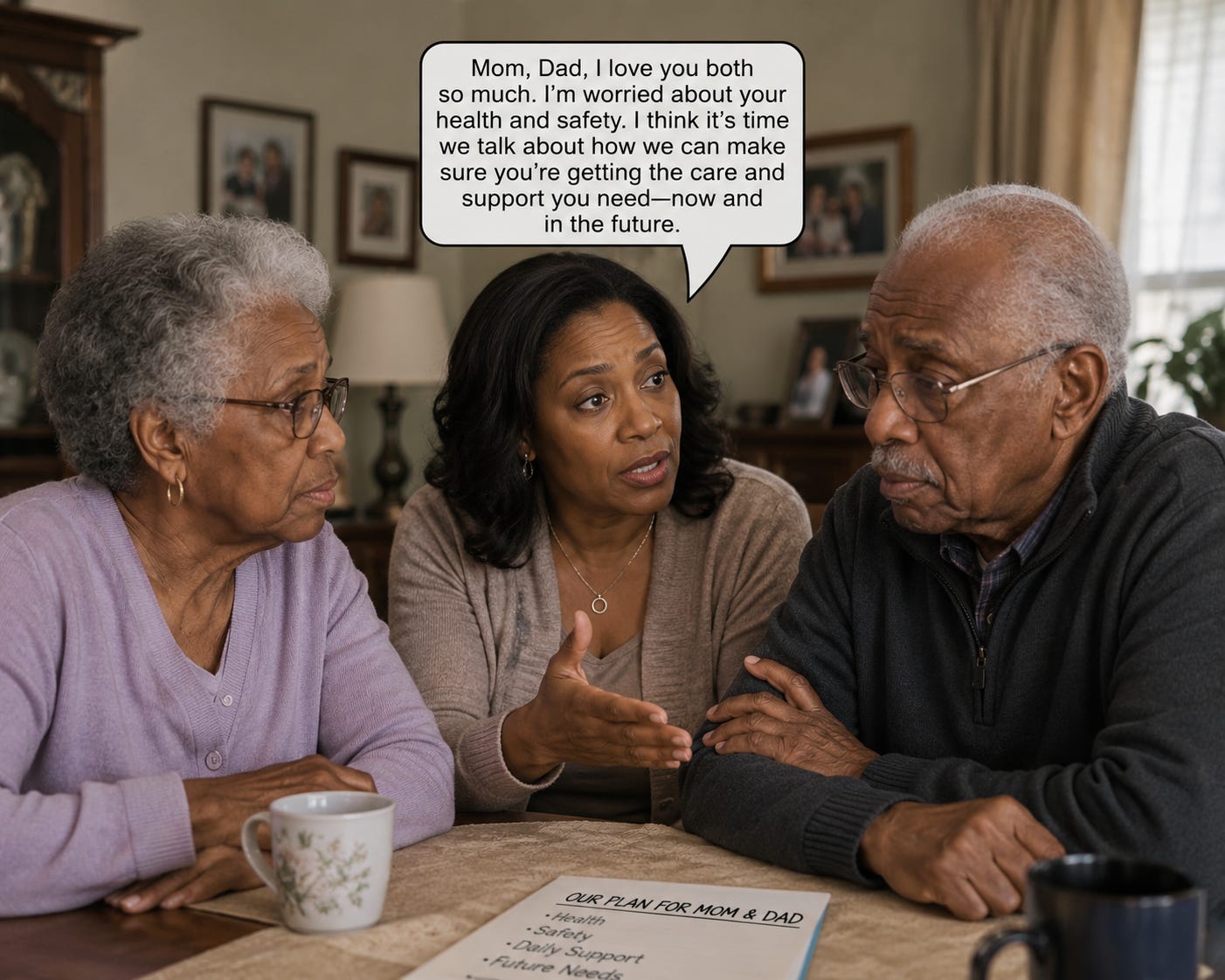
Most families don’t plan the moment they realize their parent needs help at home. It arrives during a visit — a refrigerator full of expired food, a stack of unopened mail, a bathroom that hasn’t been cleaned in weeks, a parent who seems thinner than last month and isn’t sure why. It doesn’t come with a formal announcement. It arrives quietly, and then all at once.
For Metro Atlanta families, this moment carries a specific geographic challenge. Many adult children live 30 to 90 minutes from aging parents in Fulton County, South Fulton, or surrounding Atlanta-area communities — making weekly observation difficult and warning signs easier to miss between visits. And Atlanta’s dispersed, car-dependent geography means that when a senior can no longer drive safely, they can become effectively homebound almost overnight, with no ability to access groceries, medical care, or social connection independently.
This guide covers the specific warning signs families most often miss, what home help for seniors in Atlanta actually looks like across a full spectrum of options, how to have the conversation with a resistant parent, how to fund home care, and how to recognize when home help is no longer enough. The families who navigate this best are the ones who have the right information before the crisis — not in response to it.
The Warning Signs Most Atlanta Families Miss Until It’s Too Late
Atlanta seniors are skilled at presenting well during planned visits. The house gets cleaned, energy is marshaled, concerning behaviors are suppressed for a few hours. Adult children often normalize what they see: “Dad has always been forgetful,” “Mom was never a great housekeeper.” The result is that meaningful changes in function and safety accumulate for months before anyone acts.
Physical Warning Signs
• Unexplained weight loss: Often the first and most significant indicator of self-neglect, depression, or inability to prepare adequate meals. A 10-pound loss over two months without a medical explanation warrants immediate attention.
• Unexplained bruises: Injuries the senior cannot explain or explains inconsistently indicate falls that were not reported — often because the senior feared the family’s reaction.
• Declining personal hygiene: Unwashed hair, body odor, wearing the same clothes for multiple days. This often indicates that bathing or dressing has become physically difficult, cognitively confusing, or both.
• Medication mismanagement: Pill bottles too full or too empty given the refill date, multiple prescribers with no coordination, or medications the senior cannot identify or explain.
Environmental Warning Signs in the Home
• Expired food in the refrigerator: Particularly protein items — meat, dairy, leftovers — that were forgotten rather than consumed.
• Stacking unopened mail: Bills, medical correspondence, and important documents going unread — a sign that administrative tasks have become overwhelming.
• A visibly dirtier home: Dishes in the sink, uncleaned floors, weeks of bathroom buildup — particularly significant when compared to the senior’s historical standard.
• Burn marks on the stove: Pots with burned-out bottoms or evidence of food forgotten during cooking are among the most urgent warning signs for unsupervised safety.
Behavioral and Cognitive Warning Signs
• Confusion about familiar tasks: Getting lost driving to familiar locations, forgetting how to operate the microwave or thermostat, difficulty managing a checkbook that was never a problem before.
• Withdrawal from valued activities: Stopping church attendance in communities where church was a lifelong anchor, declining invitations, stopping hobbies.
• Unusual financial activity: Large unexpected withdrawals, unpaid utilities despite adequate income, or evidence of falling victim to phone or mail scams.
The Atlanta isolation tipping point: When a Metro Atlanta senior can no longer drive safely, they often become effectively homebound almost immediately. Atlanta’s car-dependent infrastructure offers almost no walkable alternative for accessing groceries, medical care, or social connection. This driving-to-homebound transition is one of the most consequential and least-discussed warning signs for home help need.
What Home Help for Seniors in Atlanta Actually Looks Like
The most common mistake Atlanta families make is jumping to the most intensive and most expensive home care option the moment they recognize a problem. Home help for seniors in Atlanta exists on a spectrum — and starting at the appropriate level, then escalating as needs change, produces better outcomes and better sustainability than beginning at maximum intensity.
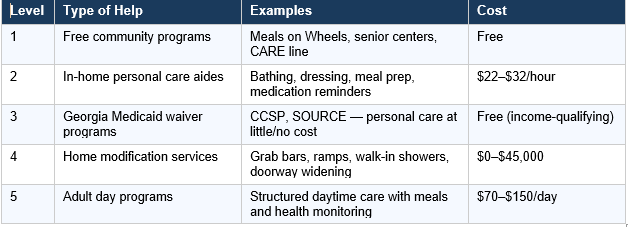
Level 1: Free and Low-Cost Atlanta Community Programs
• Meals on Wheels Atlanta: Hot meal delivery to homebound seniors — (404) 351-3889. Addresses nutrition AND provides daily human contact that serves as a functional welfare check.
• Fulton County Senior Services: Congregate meal programs at senior centers throughout Fulton County with transportation assistance. Addresses nutrition and social isolation simultaneously.
• Atlanta Regional Commission CARE line: (404) 463-3333. Connects Metro Atlanta families with the full landscape of available programs across all 10 counties. This is the most important single phone number for any family beginning this process.
Level 3: Georgia Medicaid Programs Most Families Don’t Know Exist
The Community Care Services Program (CCSP) and the SOURCE program are Georgia Medicaid waiver programs that provide in-home personal care, homemaker services, and adult day health to qualifying seniors who would otherwise require nursing home care. These programs are among the most significant and most underutilized home care funding resources in Georgia. The Georgia Medicaid CCSP home care services for qualifying Atlanta seniors are administered through the Georgia Department of Community Health — the Atlanta Regional Commission CARE line at (404) 463-3333 can guide the application process.
Level 4: Home Modification Programs in Atlanta
Physical home modifications — grab bars, ramps, walk-in shower conversions, wider doorways — can extend safe independent living significantly. Rebuilding Together Atlanta provides these modifications free for qualifying low-income seniors. Atlanta Habitat for Humanity’s Repair with Kindness program provides up to $20,000 in critical repairs including accessibility modifications for qualifying seniors through a 5-year forgivable loan. ATL Home Help Solutions assists families in evaluating whether the current home can be modified adequately for aging in place, or whether a transition to a more appropriate property ultimately serves the senior better.
How to Have the Conversation With Your Atlanta Senior Parent
No aspect of this process is harder than the initial conversation. For many Atlanta seniors — particularly in communities where self-sufficiency is a deeply held value — accepting home help can feel like the first step toward losing independence rather than a tool for maintaining it. Adult children who approach this conversation without preparation almost always make it harder than it needs to be.
When to Have the Conversation
The best time is before the crisis — when the family has noticed warning signs but no emergency has yet occurred. Have the conversation during a calm, unhurried visit in the senior’s own home when possible. Not over the phone. Not immediately after a fall, an incident, or a frightening discovery. Not when the adult child is visibly anxious or grieving what they are observing.
How to Frame It
• Lead with specific observation, not fear: “I noticed the mail had been piling up and I wanted to understand what’s been going on — not to take over, but because I love you and want to help figure out what would make things easier.”
• Frame help as protecting independence: “The goal of getting some help with these things is to make sure you can stay in your home and keep doing the things you love.”
• Involve the senior in the decision: Present options rather than decisions. Ask for their preference rather than presenting a plan as already decided.
• Use the physician’s voice: If the senior trusts their doctor, a physician recommendation for specific home supports carries authority that family input often does not.
The Atlanta Cultural Context
For Atlanta’s historically Black communities, deeply rooted values around family caregiving and self-sufficiency can make accepting formal outside help feel like a cultural betrayal. Reframing assistance as enabling the senior to remain in the family home — preserving the generational asset and the cultural anchor — often resonates more effectively than framing it as addressing decline. In many Atlanta families, the most persuasive argument is not “You need help” but “We want to make sure you can stay here, in this home, and we need to do a few things to make that possible.”
When the Senior Refuses
Resistance is common and does not mean the conversation is over. Start with the smallest, least threatening intervention: a Meals on Wheels delivery, a weekly check-in call from a senior program, a church friend stopping by regularly. These entry-level contacts often organically reveal other needs and build trust over time. If safety is an immediate and serious concern and the senior is refusing all help, contact the Atlanta Regional Commission CARE line or consult a Georgia-licensed elder law attorney about protective options.
How to Pay for Home Help for Seniors in Atlanta
Most Atlanta families assume in-home senior care is unaffordable — and then discover they haven’t accessed most of the available funding options. Georgia has more funding pathways for senior home help than most families realize.
Medicare
Medicare covers skilled home health services — skilled nursing, physical therapy, occupational therapy, speech therapy — when ordered by a physician following a qualifying hospital stay or for a documented medical need. Medicare does NOT cover personal care aide services when that is the only need. This is one of the most widely misunderstood coverage limitations. Medicare Advantage plans vary significantly — some include limited home care benefits not in traditional Medicare. Always review the specific plan’s Summary of Benefits.
Georgia Medicaid CCSP and SOURCE
For income-qualifying Atlanta seniors, these Georgia Medicaid waiver programs are the most significant in-home care funding source available — and the most underutilized. Both provide personal care, homemaker services, and other supports at little to no cost. The senior must need a nursing facility level of care but prefer and be safely able to live at home. Contact the CARE line at (404) 463-3333 or the Georgia DCH for application guidance.
VA Benefits for Atlanta Veterans
Atlanta has a substantial veteran population and VA home care benefits are significantly underutilized. The VA Aid and Attendance benefit provides $1,100 to $2,300 or more per month for qualifying veterans and surviving spouses for in-home care costs. VA Home Based Primary Care provides a full care team in the home for complex chronic care management. Apply through the Atlanta VA Medical Center at (404) 321-6111.
Home Equity Options
Home equity can fund in-home care through a HELOC, reverse mortgage, or voluntary home sale followed by transition to a more appropriate property. For Atlanta seniors who have owned their homes in appreciating neighborhoods for 10 or more years, the equity available is often substantial enough to fund years of quality care. ATL Home Help Solutions helps families evaluate which option best fits the specific property, the senior’s care needs, and the family’s long-term goals without pressure toward any particular outcome.
Long-term care insurance: Many Atlanta seniors purchased LTC insurance policies in the 1980s and 1990s with in-home care benefits that have never been claimed. Adult children should search for any LTC policies their parent holds — these often include significant home care benefits. Contact the Georgia Department of Insurance at oci.georgia.gov if there is uncertainty about whether a policy is active.
When Home Help Is No Longer Enough — Recognizing the Transition Point
Families who have worked hard to keep a parent at home have significant emotional investment in that decision continuing to work. The transition point is rarely a single dramatic moment — it is usually a gradual accumulation until a crisis forces the question. Recognizing the signs before that crisis gives families options. Missing them until after means making decisions under maximum duress.
Signs That In-Home Care Has Reached Its Limits
• Falls becoming more frequent despite modifications and aide support
• Wandering behavior or significant cognitive decline that cannot be safely managed at home with available care
• Primary family caregiver experiencing health consequences or significant burnout from caregiving demands
• Medical needs that have escalated beyond in-home management capacity
• The senior is persistently unhappy, isolated, or not thriving in the home environment
The Housing Options When Home Help Is Not Enough
Assisted living communities in Metro Atlanta range from $3,000 to $8,000 or more per month depending on care level and location, providing 24-hour support, social programming, and meals. Memory care communities offer specialized environments for seniors with dementia and Alzheimer’s. Moving in with adult children is common in Atlanta’s multi-generational family culture — but requires honest assessment of the adult child’s home, schedule, and capacity. Downsizing to a more appropriate single-story, accessible Atlanta property sometimes eliminates the primary barriers to independent living at a fraction of the cost of in-home care.
The Equity Opportunity in the Transition
For Atlanta seniors with significant equity in appreciating neighborhoods — Cascade Heights, East Point, West End, Kirkwood — the transition from the current home to a more appropriate living situation often unlocks equity that funds years of quality care. A home worth $380,000 sold by a senior transitioning to assisted living generates equity that can fund multiple years of quality care — far more than Social Security income alone could sustain. This is not loss: it is a conversion of one form of wealth into another, done deliberately and on the family’s terms.
For comprehensive information on the full range of Metro Atlanta senior services and programs, the Atlanta Regional Commission senior services and CARE line for Metro Atlanta families at atlantaregional.org provides regional program information, caregiver resources, and connection to county-level services. For Georgia-wide Medicaid home care program information, the Georgia Department of Community Health Medicaid home care waiver programs at dch.georgia.gov covers current eligibility and application processes.
Frequently Asked Questions: Home Help for Seniors in Atlanta (2026)
These are the questions Atlanta families ask most often when they recognize that a senior parent or loved one may need help at home.
Q: What is the first step when I notice my Atlanta parent needs help at home?
The first step is to call the Atlanta Regional Commission CARE line at (404) 463-3333. This free service connects Metro Atlanta families with the specific resources, programs, and agencies available for their parent’s specific situation and location. It is the single most efficient starting point because the counselors know what is currently available across all 10 Metro Atlanta counties, what the eligibility requirements are, and how to access each program. Before making any decisions or arranging any services, make this call.
Q: How much does in-home senior care cost in Atlanta?
In-home personal care aide services in Atlanta typically cost $22 to $32 per hour through a licensed agency. A part-time schedule of 4 hours per day, 5 days per week costs approximately $2,200 to $3,200 per month at current Atlanta rates. Full-time live-in care runs $5,000 to $8,000 per month. Georgia Medicaid CCSP and SOURCE programs can cover these costs at little to no cost for income-qualifying seniors. VA benefits can provide $1,100 to $2,300 or more per month for qualifying veterans and surviving spouses. Medicare covers skilled medical home health but not personal care-only services.
Q: What is the Georgia CCSP program and how do I apply?
The Community Care Services Program (CCSP) is a Georgia Medicaid waiver program providing in-home personal care, homemaker services, adult day health, and other supports to qualifying seniors who would otherwise require nursing home care. To qualify, the senior must meet both a functional level of need and financial eligibility requirements. Applications are processed through the Georgia Department of Community Health. The Atlanta Regional Commission CARE line at (404) 463-3333 can guide the entire application process and help determine eligibility before the formal application begins.
Q: My Atlanta parent refuses help at home. What can I do?
Resistance to home help is extremely common. Start with the smallest, least threatening intervention: a Meals on Wheels delivery, a call from a senior program, a trusted church friend stopping by regularly. Frame all help as protecting independence rather than addressing decline. Involve the senior in choices rather than presenting decisions. If the primary care physician recommends home support, that recommendation often carries more weight than family input. If safety is an immediate and serious concern and the senior is refusing all help, contact the Atlanta Regional Commission CARE line or a Georgia-licensed elder law attorney for guidance on protective options.
Q: What free home help programs are available for seniors in Atlanta?
Several free or low-cost programs serve Atlanta seniors: Meals on Wheels Atlanta provides free hot meal delivery to homebound seniors at (404) 351-3889. Fulton County Senior Services provides congregate meal programs with transportation assistance at most senior centers. Rebuilding Together Atlanta provides free home safety modifications for qualifying low-income seniors. Georgia CCSP and SOURCE provide free in-home care for qualifying Medicaid-eligible seniors. The Atlanta Regional Commission CARE line at (404) 463-3333 is the fastest way to access and screen for all of these simultaneously.
Q: How do I know if my parent needs assisted living vs. in-home care?
In-home care is typically appropriate when the senior has specific unmet needs the home can accommodate, a consistent caregiver can be arranged, the home can be safely modified, and the senior’s cognitive state allows safe unsupervised periods. Assisted living becomes the right consideration when care needs require 24-hour availability, falls are frequent despite modifications, dementia creates safety risks that cannot be managed at home, the family caregiver is experiencing burnout, or the senior is persistently unhappy and isolated in the home environment. The answer depends on the senior’s specific medical needs, the home environment, and the available support system.
Q: Can my Atlanta parent’s home equity pay for in-home care?
Yes, through several mechanisms. A Home Equity Line of Credit allows access to home equity while the senior remains in the home for seniors who can qualify financially. A reverse mortgage converts equity to tax-free monthly or lump-sum payments for seniors 62 and older with no monthly payment obligation. A voluntary home sale generates lump-sum equity that can fund a transition to a more appropriate living situation and cover care costs from the proceeds. ATL Home Help Solutions helps Atlanta families evaluate which option best fits the specific property, care needs, and long-term goals without pressure toward any single outcome.
Q: What should I do if I think my Atlanta parent is being financially exploited?
Financial exploitation of seniors is one of the most prevalent elder abuse forms in Georgia. Warning signs include unusual bank withdrawals, new “friends” with financial access, changes to wills or power of attorney documents, unpaid bills despite adequate income, or a senior who seems afraid to speak freely around a specific person. Contact Georgia Adult Protective Services at 1-866-552-4464 (24-hour APS hotline). Atlanta Legal Aid Society at (404) 524-5811 provides free legal assistance for qualifying seniors who have been exploited. The Fulton County District Attorney’s office has an elder abuse unit that handles criminal financial exploitation cases.
Final Thoughts: The Families Who Help Best Are the Ones Who Act Before the Crisis
The families I work with most often tell me the same thing: they wish they had called sooner. Not because the situation became dramatically worse — though it sometimes does — but because they were carrying the weight of not knowing what to do, and they didn’t have to carry it alone. Home help for seniors in Atlanta is not a single service or a single decision. It is a process of recognizing what is needed, matching it to what is available, and making thoughtful adjustments as needs change.
The warning signs in this guide are there to be acted on. The programs and resources are there to be used. And the conversation, while hard, is almost always better received than the adult child feared it would be — especially when it comes from a place of love rather than fear, and when it offers options rather than imposing decisions.
ATL Home Help Solutions — Honest Guidance for Atlanta Families Navigating Senior Home Decisions.
Whether the answer for your family is home modifications, identifying programs your parent qualifies for, a voluntary sale that unlocks equity for care, or simply understanding what every realistic option looks like before you commit to any one path — I can help you find clarity without pressure. I’m Gerald Harris, founder of ATL Home Help Solutions. I work with Atlanta and Fulton County families navigating exactly this moment — when you can see that something needs to change but you’re not sure what that looks like, what it costs, or where to start.
You don’t have to figure this out alone.
📞 Call or Text: 404-913-7086 📧 Email: gerald@atlhomehelp.com
Visit ATL Home Help Solutions — atlhomehelp.com — No pressure. No judgment. Just honest local guidance.