


Quick Answer: A loan modification in Atlanta typically lowers your monthly mortgage payment by 10% to 30%, though some programs achieve reductions of 40% or more in significant hardship cases. The actual reduction depends on your loan type (FHA, VA, or conventional), your lender’s specific program, your current interest rate, and your documented income. The goal of most modification programs is to bring your housing payment to no more than 31% of your gross monthly income.
If you’re behind on your mortgage in Atlanta and you’ve heard the words “loan modification” but still don’t know what it actually means for your monthly payment — you’re not alone. Most homeowners going through this process have no idea what number they’re actually going to end up with. Servicers use vague language. The application process is confusing. And the answers online are almost never specific to what Atlanta homeowners actually experience.
This guide gives you the real answer to the question of how much does a loan modification lower your payment — with actual dollar figures, real Atlanta-market scenarios, and a clear breakdown of every modification program available to Georgia homeowners in 2026. Whether your loan is FHA, VA, or conventional, whether you purchased at the peak in 2022 or have been in your home for 15 years, the numbers here are specific enough to be useful.
Atlanta’s median home value has risen sharply over the past five years. Homeowners who purchased or refinanced at peak prices in 2021 and 2022 are now in the highest-risk category for payment distress as rates and carrying costs have compounded. If that describes your situation, a loan modification may be the most powerful tool available to keep you in your home. But only if you understand what it will actually do to your payment before you apply.
What a Loan Modification Actually Does to Your Mortgage
Before getting to the numbers, it’s worth being clear about what a loan modification is and what it isn’t — because the most common misunderstandings about modifications lead homeowners to either underestimate what’s possible or pursue the wrong solution entirely.
A loan modification is a permanent change to the original terms of your mortgage loan — made by agreement between the lender and the borrower — that results in a lower monthly payment the homeowner can actually sustain. It is not a temporary pause. It is not a new loan. It is a change to the existing loan’s terms.
What a Modification Is Not
• Not a refinance: A refinance replaces your loan with a new one and requires credit qualification, an appraisal, and closing costs. A modification changes the existing loan without those requirements. Homeowners who can’t qualify for a refinance can still qualify for a modification.
• Not forbearance: A forbearance temporarily pauses or reduces payments but requires full repayment later. A modification permanently changes the terms going forward.
• Not debt forgiveness: In most cases, a modification does not reduce the principal balance you owe. It changes how you repay it — at a lower rate, over a longer period, or both.
The Four Tools Lenders Use to Modify a Loan
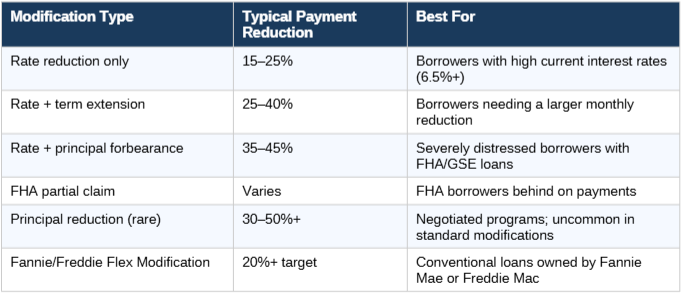
Interest rate reduction — The most common and most impactful modification lever. Lowering the rate from 7.5% to 4% on a $250,000 balance reduces the monthly payment by $400 to $500 per month.
Loan term extension — Extending a loan that has 22 years remaining back out to 40 years lowers the payment by spreading amortization over a longer period. Less impactful than rate reduction when used alone, but frequently combined with it for larger payment reductions.
Principal forbearance (deferral) — A portion of the outstanding balance is set aside as a non-interest-bearing balloon payment due at end of the loan or payoff. The monthly payment is calculated on the reduced remaining balance. The deferred amount is still owed — this is deferral, not forgiveness.
Principal reduction — The rarest modification type. The lender actually forgives a portion of what you owe. Uncommon in standard programs but exists in specific FHA and VA modifications and certain negotiated settlements.
The target payment: Most modification programs aim to achieve a housing payment — principal, interest, taxes, and insurance combined — of 31% or less of the borrower’s gross monthly income. This 31% threshold originated in the government’s HAMP program and remains the benchmark most servicers use when evaluating modification cases today.
How Much Does a Loan Modification Lower Your Payment — Real Atlanta Numbers
Here is the direct answer with real dollar calculations using Fulton County-relevant loan balances. These scenarios reflect the actual modification structures being used in Atlanta’s market.
Scenario 1: Interest Rate Reduction Only
A homeowner in East Point purchased in 2022 with a $280,000 loan balance at 7.5%. With 25 years remaining, the monthly principal and interest payment is approximately $2,065. After a modification that reduces the rate to 4.5% with the same 25-year term remaining, the payment drops to approximately $1,556. Monthly savings: $509. That is a 24.6% reduction from a rate-only modification — the most common scenario for Atlanta homeowners who purchased or refinanced during the 2021–2022 rate peak.
Scenario 2: Rate Reduction Plus Term Extension
Same $280,000 balance at 7.5%. Modified to 4.5% with the term extended to 40 years. Monthly payment drops to approximately $1,271. Monthly savings: $794 per month — a 38.4% payment reduction. This is a common FHA modification structure and one of the most powerful tools available for Atlanta homeowners with FHA-insured loans who need a significant payment reduction to stay in the home.
Scenario 3: Rate Reduction Plus Principal Forbearance
A homeowner has a $300,000 balance. The servicer agrees to forbear $40,000 of the principal as a non-interest-bearing balloon payment. The modified payment is calculated on the remaining $260,000 at a 4% rate over 30 years — approximately $1,241 per month. The original payment at 7.5% on $300,000 was approximately $2,097. Monthly savings: $856 per month — a 40.8% reduction. The $40,000 forborne amount is owed when the home is sold, refinanced, or the loan matures.
Scenario 4: FHA Partial Claim
For FHA-insured loans, the lender can advance funds from the FHA insurance fund — up to 30% of the unpaid principal balance — to bring the loan current. The advanced amount becomes an interest-free second lien due when the home is sold or refinanced. The regular first mortgage continues with its original rate and term. The homeowner’s monthly payment returns to the pre-delinquency amount, with the delinquent balance removed from the regular bill. Many Atlanta homeowners with FHA loans have used this option without fully realizing a second lien has been placed on their title — important to know before any future sale or refinance.
The floor: If your current rate is already low — say 3.5% from a 2019 refinance — a rate reduction modification may produce little to no change. Term extension becomes the primary lever and the reduction may be modest. Conversely, loans at 7% or higher have significant modification room, and payment reductions of $800–$1,200 per month are possible with the right program.
Loan Modification Programs Available to Atlanta Homeowners in 2026
The specific modification program available to you depends on who insures or owns your loan. Knowing your loan type is step one. Call your servicer and ask directly, or use the free lookup tools below.
FHA Loan Modification Programs
FHA-insured loans are very common in Atlanta’s first-time buyer and lower-to-middle price range markets — East Point, College Park, Cascade, and Decatur carry high concentrations of FHA loans. FHA borrowers have access to several defined modification programs:
• FHA Standard Modification: Reduces the interest rate to the current market rate and extends the term to 30 or 40 years. No specific payment reduction target, but the rate reduction and term extension typically achieve 20–35% payment reduction.
• FHA-HAMP Modification: Specifically designed to achieve a 25% or greater reduction in the monthly mortgage payment. Uses a combination of rate reduction, term extension, and principal forbearance to hit that target.
• COVID-19 Standalone Partial Claim: Allows servicers to advance up to 30% of unpaid principal as an interest-free second lien to bring the loan current. The regular payment continues unchanged. The advanced amount is repaid at sale or refinance.
VA Loan Modification
Veterans with VA-guaranteed loans have access to the VA’s refund modification program, which can extend the loan term to 30 years from the modification effective date and may include a rate reduction to the current market rate. Atlanta homeowners in communities near Dobbins Air Reserve Base, the former Fort Gillem area, and Hartsfield-adjacent communities should verify VA loan status if their loan was taken in connection with military service.
Fannie Mae and Freddie Mac Flex Modification
The current standard program for conventional loans owned by Fannie Mae or Freddie Mac, the Flex Modification targets at least a 20% reduction in the monthly principal and interest payment. It extends the term to 480 months (40 years) from the modification effective date and may include an interest rate reduction if needed to hit the 20% target. To confirm whether Fannie Mae owns your loan, use the Fannie Mae loan lookup tool to check your Atlanta mortgage. Freddie Mac has a similar free lookup tool at freddiemac.com.
Proprietary and In-House Servicer Modifications
For loans not covered by FHA, VA, or GSE programs — including non-QM loans, portfolio loans, and private-label securitized mortgages — the servicer may offer an in-house or proprietary modification. Terms vary by servicer and no standardized program or guaranteed reduction percentage exists. Negotiation is more open-ended and the outcome less predictable, but these modifications are still available and worth pursuing.
Do You Qualify for a Loan Modification in Atlanta? What Lenders Actually Look For
The most common reason Atlanta homeowners don’t pursue a loan modification is fear of rejection. That fear is frequently unfounded. The eligibility criteria for most modification programs are broader than homeowners assume, and the application itself costs nothing.
Core Eligibility Factors
• Financial hardship: You must demonstrate a qualifying hardship — job loss, income reduction, medical expenses, divorce, death of a co-borrower, or a significant increase in housing expenses. The hardship letter is one of the most important documents in the application.
• Ability to make the modified payment: This is the most critical factor. You don’t need to be able to make your current payment. You need to demonstrate you can make a reduced modified payment. Stable income of any kind — employment, Social Security, pension, disability, rental income — strengthens the application.
• Primary residence: Most programs require owner-occupancy. Investment properties and second homes have limited modification options.
• Default or imminent default: Most programs require the borrower to be in default or at imminent risk of default. Being current on payments can make it harder to qualify, though some programs have removed this requirement.
Who Commonly Qualifies in Atlanta’s 2026 Market
• Homeowners who purchased at 6.5–7.5% rates in 2021–2022 and have experienced any income reduction
• Senior homeowners on fixed Social Security income whose property tax bills have escalated
• Homeowners who had COVID-era forbearances that were not properly resolved at expiration
• Divorced homeowners now servicing a mortgage on a single income that originally required two
Documentation Required
• Signed hardship letter — specific, honest, one to two pages
• Last two pay stubs or SSA award letter / pension statement if no earned income
• Last two bank statements
• Last two federal tax returns
• Monthly income and expense worksheet
• Proof of any additional income sources
Free HUD-approved housing counselors can help prepare a complete, compelling application and communicate with the servicer on your behalf. Research consistently shows that homeowners who apply with professional support have significantly better outcomes. The CFPB’s complete guide to requesting a mortgage loan modification covers the full federal framework that governs servicer behavior during the modification review process.
How to Apply for a Loan Modification in Atlanta — Step by Step
The application process is well-defined and free. The most critical rule: submit a complete application. A complete application — not a partial one — triggers the CFPB’s dual-track prohibition, which legally prevents your servicer from advancing the foreclosure clock while your application is under review.
1. Identify your servicer’s loss mitigation department: Do not call the general customer service line. Ask specifically for the loss mitigation department. Get a direct number, name, and submission address. Your servicer is the company you make monthly payments to — it is not necessarily your original lender.
2. Request the official loss mitigation application packet: Ask for the Borrower Response Package (BRP) or equivalent forms specific to your servicer. This is the starting point for a formal modification request.
3. Write a compelling hardship letter: State the specific hardship event, when it occurred, how it affected your ability to pay, what has changed, and why you believe you can sustain a modified payment. Be specific, honest, and concise — one to two pages. This document is read by a human loss mitigation specialist.
4. Gather and submit all documentation as a complete package: Do not submit documents piecemeal. A complete, organized submission is what triggers the dual-track protection. Confirm receipt in writing and document the submission date.
5. Follow up every 10 to 14 days: Servicer loss mitigation departments are often understaffed. Escalate to a supervisor if you have not received written acknowledgment within five business days. Keep a detailed log of every contact: date, time, representative name, and the substance of the conversation.
6. Review the modification offer carefully before signing: Verify the new interest rate, new monthly payment, new loan term, and any balloon payment amounts. Confirm the new payment is actually sustainable. A modification you accept and then re-default on is worse than not modifying at all. If any terms are unclear, get a HUD counselor or real estate attorney to review before you sign.
Appeal rights: If your modification is denied, you have the right to appeal. The appeal must typically be filed within 14 days of receiving the denial notice. Grounds include servicer calculation errors, documentation submitted but not reviewed, or a change in financial circumstances. Do not accept a denial without asking specifically whether an appeal is available and what the deadline is.
Loan Modifications and Your Credit — What Atlanta Homeowners Need to Know
Many Atlanta homeowners avoid applying for a modification because they fear it will destroy their credit. This fear is understandable but overestimated. The reality of how modifications affect credit — and how that impact compares to the alternatives — should make the decision clear.
How Modifications Are Reported
A completed loan modification is typically reported to the credit bureaus as “modified” or “modified under a federal or state program.” This notation affects your credit score — typically by 50 to 100 points — but the impact is temporary and improves steadily as you make on-time modified payments. The delinquency that led to the modification has already been reported and is already on your credit history. The modification itself is not the primary source of credit damage.
The Comparison That Matters
Loan modification: 50–100 point temporary credit impact. Score recovers with consistent on-time modified payments. No public courthouse record.
Foreclosure: 100–160 point impact. Remains on credit report for seven years. Becomes a public record in county deed files, visible to landlords, lenders, and employers who run public record checks.
A modification is always the better credit outcome compared to foreclosure. The choice is not between a perfect credit record and a modification. The choice is between two imperfect outcomes, one of which is significantly less damaging and preserves your housing.
Future Mortgage Eligibility After Modification
• FHA guidelines: No mandatory waiting period after a modification if payments have been current for 12 months after the modification effective date.
• Conventional (Fannie Mae/Freddie Mac): Generally requires 24 months of on-time post-modification payments before a new purchase mortgage is approved.
The Tax Question
In most cases, a loan modification that reduces your interest rate does not create a taxable event. However, if principal is actually forgiven — reduced, not deferred — the forgiven amount may be treated as cancellation of debt income by the IRS depending on current law and your specific financial circumstances. Always consult a tax professional before accepting any modification that includes principal reduction rather than deferral.
What to Do When a Loan Modification Isn’t Enough — Atlanta-Specific Options
A loan modification is the right answer for homeowners who want to stay in their home and have income to sustain even a reduced payment. It is not the right answer for every situation. Here is how to think through the alternatives when modification doesn’t fully close the gap.
When Modification May Not Be Sufficient
• The modified payment is still unaffordable relative to current income
• Concurrent property tax delinquency (active Fi. Fa. lien) makes the total carrying cost unsustainable even with a reduced mortgage payment
• The home requires significant repairs that cannot be funded on a modified budget
• The homeowner is underwater by a large amount with no viable long-term path to equity
Alternative Paths for Atlanta Homeowners
Forbearance Plus Sale: Accept a temporary forbearance to stop the foreclosure clock, use that time to list and sell the property, pay off all obligations at closing, and capture any remaining equity. For homeowners with equity who are realistic about needing to exit, this often produces a better financial outcome than a modification that eventually re-defaults.
Short Sale: If the mortgage balance exceeds the current property value, a short sale with lender approval allows an exit without a completed foreclosure on the credit record. Confirm the deficiency waiver in writing before closing.
Deed in Lieu: For underwater properties where a sale isn’t practical, voluntarily transferring title to the lender in exchange for release of the mortgage obligation. Faster than foreclosure, better for credit, and sometimes includes relocation assistance.
As-Is Cash Sale: For homeowners with equity who need to exit quickly, a cash sale can close in 7 to 21 days, pay off all obligations including delinquent taxes and mortgage arrears at closing, and put proceeds in the homeowner’s hands. ATL Home Help Solutions works with Atlanta homeowners to evaluate whether a sale produces a better net outcome than modification — and to connect them with credible buyers when it does.
The Fulton County Property Tax Intersection
Many Atlanta homeowners facing mortgage default are simultaneously behind on property taxes. A modification that reduces the mortgage payment but doesn’t address a $6,000 delinquent tax balance and growing Fi. Fa. lien is an incomplete solution. Both problems must be addressed together for housing stability to actually improve. For guidance on the full scope of your property’s financial situation, the Georgia Legal Aid housing resources for Atlanta homeowners facing foreclosure and the HUD-approved housing counselor locator near Atlanta are both free starting points that can connect you with the right local expertise.
Final Thoughts: The Number You’re Looking for Is Achievable — If You Apply
The question of how much does a loan modification lower your payment has a real answer for your specific loan: somewhere between 15% and 45% depending on your loan type, current rate, and the modification program you qualify for. For an Atlanta homeowner with a 7% rate on a $280,000 balance, that range translates to $400 to $800 per month in real, permanent payment relief.
What stands between most Atlanta homeowners and that relief is not eligibility — it is inaction. The application is free. The process is defined. The CFPB’s dual-track prohibition protects you while your application is under review. And free HUD-approved housing counselors in Atlanta can help you prepare and submit a complete, compelling application that maximizes your chance of approval.
If you are behind on your mortgage or heading in that direction, the time to apply is now — not after the next missed payment, and not after a Notice of Sale appears in the Daily Report.
Not Sure if a Loan Modification Is the Right Move? Let’s Find Out Together.
If you’re trying to figure out whether a loan modification will actually lower your payment enough to make staying in your Atlanta home realistic — or whether selling, a short sale, or another path makes more sense for your situation — reach out to ATL Home Help Solutions today. I’m Gerald Harris, and I work with Fulton County homeowners who are weighing these options. I can help you understand what payment reduction is realistic for your specific loan, what the real alternatives look like, and which path actually puts you in a better financial position — not just for this month, but long-term. No pressure. No agenda. Just honest guidance.
The right next step starts with a real conversation.
📞 Call or Text: 404-913-7086 📧 Email: gerald@atlhomehelp.com
Visit ATL Home Help Solutions — Contact Gerald Harris — No pressure. No judgment. Just honest local guidance.