

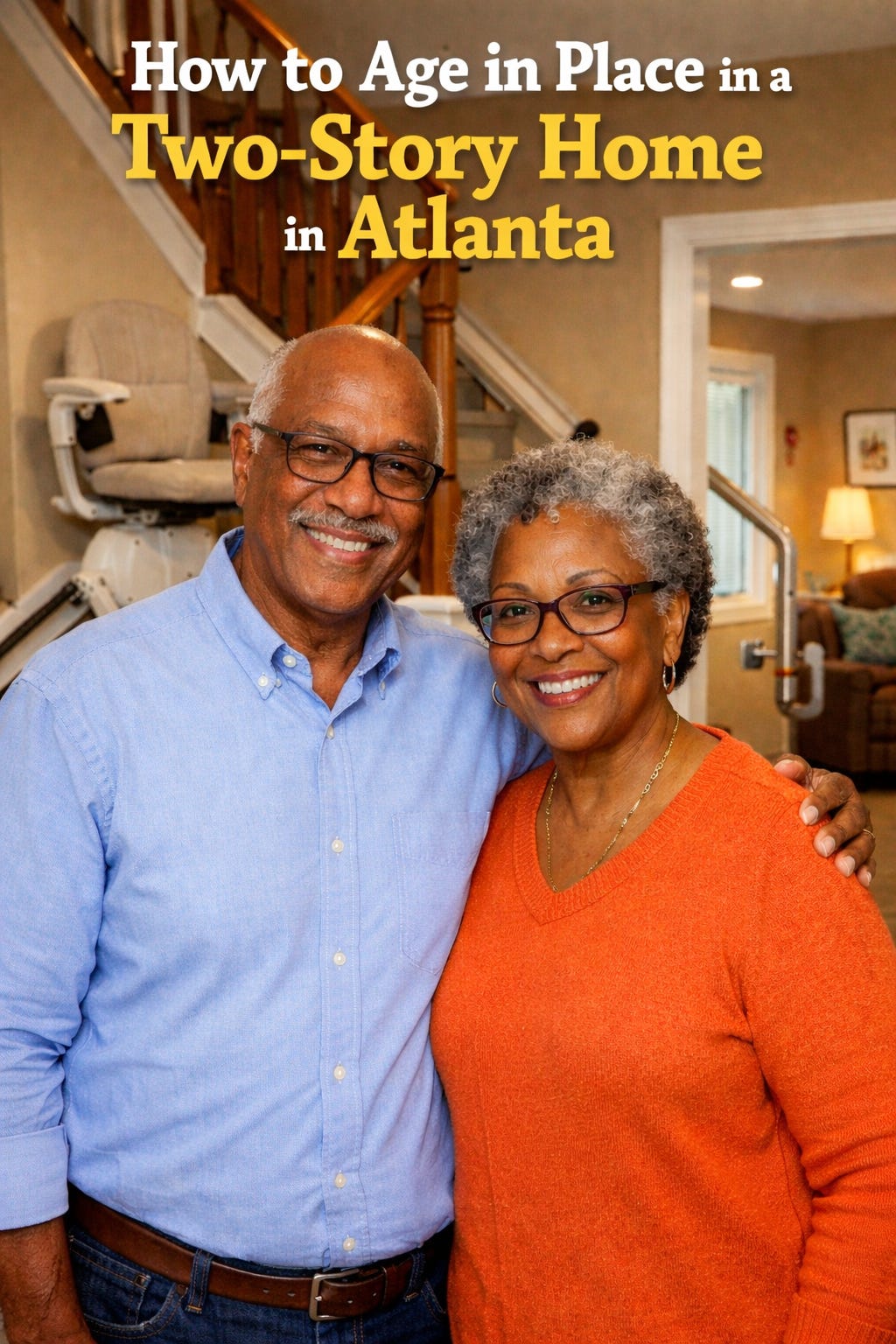
Quick Answer: To age in place in a two-story Atlanta home: (1) create a complete main-level living suite so stairs become optional rather than required for daily life, (2) install a stair lift or residential elevator for continued upper-level access, (3) modify bathrooms with grab bars, roll-in showers, and non-slip surfaces, (4) improve lighting and reduce trip hazards throughout, and (5) explore Atlanta-specific programs that can help fund these modifications at low or no cost.
You’ve lived in your two-story Decatur home for 28 years. The master bedroom is upstairs. The laundry is in the basement. The steps to the front door have no railing. You’re 71 years old and you have no intention of moving — but your body is starting to have opinions about those stairs. Sound familiar?
Learning how to age in place in a two-story home is one of the most common challenges facing Atlanta’s senior homeowners right now. A significant portion of Metro Atlanta’s housing stock — particularly homes built between 1970 and 2000 in Fulton, DeKalb, Cobb, and Gwinnett counties — is two stories. These homes were designed for families with children, not for adults in their seventies and eighties navigating stairs twice a day. But they can be modified significantly without rebuilding from scratch, and in Atlanta’s market, staying in a familiar home in a familiar neighborhood is often the right financial and emotional choice.
This guide walks you through every practical step: from creating a main-level living suite that makes the upper floor optional, to stair lifts and elevators, bathroom safety, smart home technology, and the Atlanta-specific programs that can help pay for all of it. And at the end, we’ll be honest about the situations where modification may not be the right answer — and what the alternatives look like in today’s Atlanta market.
Why Two-Story Homes Present Unique Aging-in-Place Challenges in Atlanta
In a single-story home, aging-in-place modifications are primarily about accessibility and fall prevention within one horizontal level. In a two-story home, there is an additional structural challenge: the vertical separation between living spaces. Everything that matters — the bedroom, the bathroom, sometimes the laundry — may be on a different floor from where you spend most of your day.
According to the CDC, falls are the leading cause of both injury-related death and non-fatal injury in Americans over 65. Stairs are the most dangerous single feature in the home for older adults — and in a two-story home, they are unavoidable unless the home is strategically reconfigured. This is not a hypothetical risk. It is the most common source of serious injury among Atlanta’s senior homeowners.
Atlanta’s Two-Story Housing Stock
Metro Atlanta’s two-story homes are heavily concentrated in neighborhoods built between 1970 and 2000. These include large four-bedroom two-story colonials in Sandy Springs, Alpharetta, Johns Creek, and Roswell where all the bedrooms are upstairs. DeKalb County neighborhoods like Dunwoody, Chamblee, and Stone Mountain have concentrations of two-story townhomes and detached homes from the same era. South Fulton and East Point have two-story brick ranches and split-levels. Older in-town Atlanta neighborhoods like Druid Hills, Decatur, and Brookhaven feature two-story craftsman and colonial homes that present their own layout constraints.
The Specific Access Problems These Homes Create
• Master bedroom upstairs: starting and ending every day requires stair navigation
• Full bathrooms only upstairs: no accessible bathroom on the main level
• Laundry in the basement: requires navigating two separate stair traversals for a daily task
• Garage entry with steps: exterior accessibility is compromised before the homeowner even reaches the main floor
• Narrow doorways: standard doorways in Atlanta’s pre-1990 homes are often 28–32 inches — too narrow for walkers and wheelchairs
The good news: every one of these problems has a proven solution. The question is which solutions fit your home, your budget, and your timeline. That’s exactly what this guide walks through.
Step 1 — Create a Complete Main-Level Living Suite
This is the single most important aging-in-place modification for a two-story home. Once a complete, self-sufficient living space exists on the main level, stairs become optional rather than required for daily life. The upper level doesn’t disappear — it simply becomes optional, which fundamentally changes the safety profile of the home.
What a Complete Main-Level Suite Requires
• A bedroom or sleeping space on the main level
• A full accessible bathroom on the main level with roll-in or walk-in shower capability, grab bars, and accessible fixtures
• Main-level laundry — relocating the washer and dryer from a basement or upper floor is one of the most impactful modifications available
• Main-level kitchen access (almost always already present)
• A comfortable main-level living area for daily activity
The Room Conversion Option
Many Atlanta two-story homes from the 1970s and 1990s have a formal dining room or a study that is rarely used. Converting one of these spaces into a main-level bedroom is often the most cost-effective aging-in-place modification available. It requires no structural changes to the exterior, no stair modifications, and no new footprint. The average cost in Metro Atlanta: $5,000 to $15,000 depending on the scope and whether an existing half-bath can be converted or a new bathroom must be added.
Adding or Converting a Main-Level Bathroom
If the home has a half bath on the main level, converting it to a full accessible bathroom with a curbless shower typically costs $12,000 to $22,000 in Atlanta’s current construction market. Adding a full bathroom from scratch where none existed runs $18,000 to $35,000. This is a significant investment — but compared to the ongoing fall risk of daily stair use, it is also one of the most medically consequential modifications available.
Relocating the Laundry
Moving laundry from a basement or second floor to the main level is one of the most practical and least discussed aging-in-place modifications. A main-level laundry closet can typically be installed in most Atlanta homes for $2,500 to $6,000 depending on plumbing proximity. The result is the elimination of one of the most frequent stair-use events in any household.
Many Fulton County and DeKalb County homes from this era have open floor plans on the main level that make bedroom conversion straightforward. Homes in older Buckhead, Druid Hills, and Grant Park may have formal layout constraints that require more creative planning — but rarely make conversion impossible.
Step 2 — Stair Lifts, Elevators, and Vertical Access Solutions
Once a main-level living suite is created, the upper floor becomes optional for daily life. But optional is not the same as inaccessible. Many Atlanta seniors want to maintain access to guest rooms, grandchildren’s visits, personal storage, or simply personal independence. Here are the three main vertical access solutions available in Metro Atlanta.
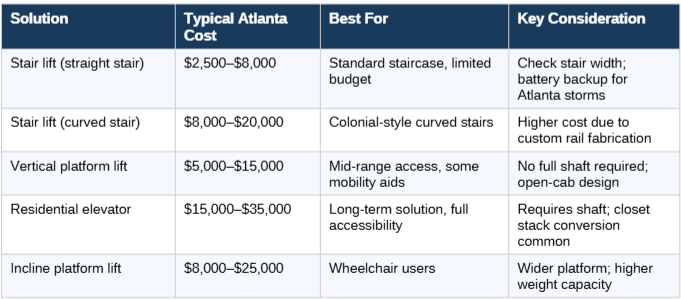
A stair lift is the most common and least expensive vertical access solution for Atlanta’s two-story homes. Installation typically takes 2 to 4 hours. Several Atlanta-area dealers service and install stair lifts throughout Metro Atlanta, representing reputable brands including Bruno, Acorn, and Stannah. Battery backup is an important feature in Atlanta specifically — the area experiences regular storm-related power outages, and a stair lift without battery backup is non-functional when it’s needed most. Rental options are also available for temporary use after surgery or injury. The AARP home fit guide for making a two-story home accessible includes a detailed checklist for evaluating stair lift options and determining which type of lift fits a given staircase configuration.
Residential Elevators
A full residential elevator is the most permanent and seamless vertical access solution — and it is more common in Atlanta’s older two-story homes than many homeowners realize. Most Atlanta homes from this era have closets stacked directly on top of each other on the first and second floors — a configuration that can often be converted into an elevator shaft without structural modification to the surrounding walls. For homeowners planning to stay in the home for 10 or more years, the investment in a residential elevator typically justifies the cost in both safety and quality of life.
The ROI Consideration
Installing a stair lift or elevator is primarily a livability investment, not a financial one. It does not typically increase resale value dollar-for-dollar. However, it significantly expands the eventual buyer pool when the home is sold — particularly relevant as Metro Atlanta’s population ages and demand for accessible two-story homes grows. Think of it as expanding future marketability while solving a present safety problem.
Step 3 — Bathroom and Fall Prevention Modifications That Matter Most
The bathroom is the most dangerous room in the home for older adults. More than 235,000 Americans visit emergency rooms annually due to bathroom injuries, with falls in the tub or shower being the most common cause. For Atlanta seniors aging in place in a two-story home — particularly if a main-level bathroom conversion is still pending — bathroom modifications are not optional. They are medical necessities.
Grab Bars: The Highest-ROI Safety Investment
Grab bars adjacent to the toilet, inside the shower or tub, and on the entry wall of the shower are the most impactful and least expensive bathroom modification available. Professional installation in Atlanta costs $150 to $400 per bar when mounted correctly into wall studs or with proper backing.
Critical warning: suction-cup grab bars are not safe and should never be used as a replacement for properly mounted grab bars. A grab bar that pulls out of the wall during a fall causes the fall instead of preventing it. Installation into studs or blocking is non-negotiable.
Rebuilding Together Atlanta installs grab bars at no cost for qualifying low-income seniors across Metro Atlanta. This is one of the most impactful free services available to Atlanta’s senior homeowner community and is dramatically underutilized.
Walk-In Shower Conversion
Converting a standard tub/shower combination to a curbless, roll-in shower eliminates the most dangerous transfer move in the bathroom — stepping over a tub wall. Cost in Atlanta: $4,000 to $12,000 depending on tile work, glass configuration, and drain placement. A curbless, zero-threshold shower is the gold standard for aging in place: no step to navigate, fully wheelchair accessible when needed, and dramatically safer for all mobility levels. Non-slip tile or applied non-slip treatment is required regardless of shower type.
Comfort-Height Toilet and Nighttime Lighting
An ADA-compliant comfort-height toilet at 17 to 19 inches is significantly easier to use than a standard 15-inch toilet for adults with limited mobility. Cost installed in Atlanta: $400 to $800. For nighttime navigation from bedroom to bathroom — one of the primary fall risk scenarios — motion-activated nightlights along the pathway and inside the bathroom are among the highest-ROI safety investments available at $20 to $50 per unit. The National Institute on Aging home safety checklist for older adults provides a room-by-room evaluation framework specifically designed for the falls prevention needs of adults over 65.
Step 4 — Smart Home Technology and Exterior Modifications
Technology has transformed aging in place in the past decade. Atlanta seniors today have access to tools that provide safety, monitoring, and convenience without requiring major structural modifications. Combined with targeted exterior improvements, they complete a comprehensive aging-in-place plan for a two-story Atlanta home.
Lighting Improvements
Inadequate lighting is the most underaddressed home safety issue for Atlanta seniors. Motion-activated lighting in stairwells, hallways, and bathrooms significantly reduces nighttime fall risk. Smart bulbs and automated lighting schedules ensure the home is never dark during nighttime navigation. In Atlanta’s older housing stock, outdated light switch placement — only at the bottom of a staircase, for example — can be addressed with remote-controlled switches or smart lighting hubs at minimal cost.
Voice-Activated Assistants and Smart Thermostats
Amazon Echo, Google Nest, and Apple HomePod devices allow seniors to control lights, locks, thermostats, and appliances without navigating to physical controls. In Atlanta’s extreme summer heat — where heat index values regularly exceed 100°F — remote thermostat control is a genuine health safety feature, not merely a convenience. A senior who cannot easily reach the thermostat is at real risk of heat-related illness during Atlanta’s July and August peak heat events.
Medical Alert Systems and Fall Detection
Fall detection pendants and wristbands with automatic fall detection and two-way voice communication provide a critical safety layer for seniors aging in a two-story home alone. Modern systems from providers like Medical Guardian, Bay Alarm Medical, and others include GPS-enabled devices for fall detection outside the home. Monthly cost: $20 to $60 depending on features. For Atlanta seniors whose adult children live out of state or across the metro, these systems provide both safety and peace of mind that no other modification can replicate.
Exterior Modifications
• Ramp construction: Step-free entry is critical for walker and wheelchair users. Ramp construction in Atlanta: $1,500 to $8,000 depending on rise height and materials.
• Handrail installation: Required on all exterior steps. Cost in Atlanta: $300 to $1,200.
• Doorway widening: Standard doorways in Atlanta’s pre-1990 homes are often 28 to 32 inches. ADA-accessible minimum is 32 inches clear. Widening costs $800 to $2,000 per doorway.
• Smart locks: Eliminates fine motor challenges of keys — important for seniors with arthritis. Allows family members and home health aides to enter without the homeowner navigating to the door. Cost: $150 to $400 per lock installed.
Programs That Help Atlanta Seniors Pay for Two-Story Home Modifications
The most common reason aging-in-place modifications don’t get done in Atlanta’s senior homeowner community is cost. The programs below exist specifically to address that barrier — and the majority of Atlanta seniors who qualify have never applied for any of them.
Atlanta Habitat for Humanity — Repair with Kindness Program: Provides up to $20,000 in critical home repairs through a 5-year forgivable loan. Specifically prioritizes seniors age 55 and older. Covers accessibility modifications including ramps, grab bars, and structural repairs in select Atlanta and South Fulton County neighborhoods. Applications through atlantahabitat.org.
Rebuilding Together Atlanta: Free home repairs and accessibility modifications for low-income elderly homeowners across Metro Atlanta. Specifically focused on grab bar installation, wheelchair ramps, safety lighting, and trip hazard removal. The Rebuilding Together Atlanta free accessibility modifications for seniors program accepts applications year-round and has served Atlanta seniors for decades.
City of Atlanta Emergency Home Repair Program: Free emergency repairs for income-qualifying homeowners within Atlanta city limits. Covers HVAC, roof, electrical, plumbing, and accessibility modifications in emergency situations. Administered through the City of Atlanta’s Office of Housing.
Georgia Department of Community Affairs HOME Program: Federally funded program that can support accessibility modifications for qualifying low-to-moderate income homeowners. Contact the Georgia DCA directly for current program availability in Fulton County.
Fulton County Property Tax Exemptions: Not a repair program, but by reducing annual property tax liability by $1,000 to $2,000 or more for qualifying seniors age 62 and older, these exemptions free up income that can be directed toward modification costs. Apply through the Fulton County Tax Commissioner’s senior exemption portal before April 1 of each tax year. Many qualifying seniors have never applied.
AARP Foundation HomeFit Program: Free online guide and consultation resources to help homeowners identify and prioritize modifications. AARP also offers free home assessments in some markets and maintains one of the most comprehensive aging-in-place planning resources available nationally.
Atlanta Regional Commission CARE Line: (404) 463-3333. Connects seniors and caregivers with local resources including home modification programs, in-home support services, and financial assistance across Fulton, DeKalb, Cobb, Clayton, and surrounding counties.
When Aging in Place in a Two-Story Home May Not Be the Right Answer
This is the section most aging-in-place guides skip. Honest guidance requires acknowledging that even a well-modified two-story home is not the right long-term answer for every situation. Understanding when to reconsider — and what the alternatives look like — is as important as knowing how to modify.
Warning Signs That Modification May Not Be Enough
• Multiple recent falls on the stairs that have resulted in injury or near-misses
• Significant cognitive decline that makes independent navigation of a multi-level home a genuine ongoing safety risk
• Physical limitations — advanced mobility impairment, post-stroke conditions, late-stage COPD — that make even a stair lift impractical
• A home with a layout that makes true main-level conversion cost-prohibitive, such as a two-story townhome with no viable bedroom space on the ground floor
• Deferred maintenance so severe that the total modification budget approaches the cost of selling and purchasing a purpose-built single-story home
The Honest Financial Calculation
A full two-story aging-in-place modification — stair lift ($5,000) plus bathroom conversion ($15,000) plus main-level bedroom conversion ($12,000) plus laundry relocation ($4,000) — totals approximately $36,000. If the modified home serves the senior’s needs for 10 or more years, this is typically a sound investment. If the senior’s needs are likely to exceed what even a modified two-story home can accommodate within three to five years, a move to a single-story home, an age-restricted community, or assisted living may produce a better quality-of-life and financial outcome.
The Equity Opportunity
Many long-term Atlanta homeowners in two-story homes have accumulated $150,000 to $300,000 or more in equity. Selling a two-story home in a strong Atlanta market and purchasing a purpose-built single-story home in an active adult community within the same Metro area is a legitimate and often financially sound path. A voluntary as-is sale through ATL Home Help Solutions’ network of cash buyers can close in 7 to 21 days — generating proceeds that fund a move to a safer, more appropriate living situation without months of uncertainty.
The Heirs’ Property Consideration
Many two-story Atlanta homes in historically Black neighborhoods carry heirs’ property title complications — situations where the home has passed through generations without formal deed transfers or probate proceedings. This affects both modification program eligibility and eventual sale proceeds distribution. Resolving heirs’ property before making major modifications protects the entire family’s investment in whatever improvements are made. The Atlanta Legal Aid Society at (404) 524-5811 provides free legal assistance for qualifying families dealing with heirs’ property situations.
Final Thoughts: Your Two-Story Atlanta Home Can Work for the Next Chapter — With the Right Plan
The two-story home you’ve raised a family in, built equity in, and established community around does not have to be the home you leave. With a thoughtful modification plan — a main-level living suite, accessible vertical access, bathroom safety improvements, and smart home technology — most two-story Atlanta homes can be made safe, comfortable, and functional for aging in place for a decade or more.
The key is having a plan, not waiting for a fall to prompt action. And the key to a plan is understanding your specific home, your specific neighborhood, and which of Atlanta’s available programs can help make those modifications financially accessible.
Ready to Make Your Two-Story Atlanta Home Work for the Long Term? Let’s Talk.
Whether you’re trying to figure out how to make your two-story Atlanta home work for the next 20 years, or you’ve realized that modification isn’t enough and you’re ready to explore what a transition looks like — ATL Home Help Solutions is here to help. I’m Gerald Harris. I work with senior homeowners and their families across Fulton County and Metro Atlanta who are navigating exactly this kind of decision. I can help you evaluate your specific home’s modification potential, connect you with the right local programs and contractors, or walk through what a sale and transition would actually look like in your market.
No pressure. No rush. Just honest guidance from someone who knows this market.
📞 Call or Text: 404-913-7086 📧 Email: gerald@atlhomehelp.com
Visit ATL Home Help Solutions — Contact Gerald Harris — No pressure. No judgment. Just honest local guidance.