


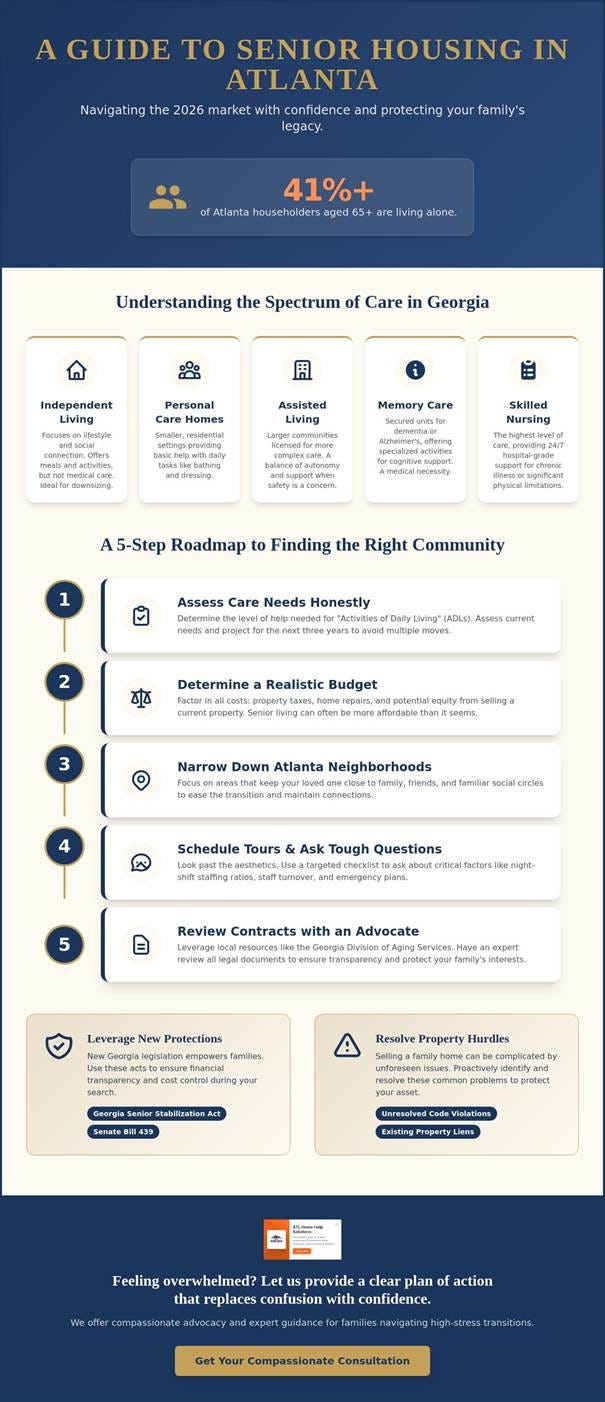
Did you know that more than 41% of Atlanta householders aged 65 and over are currently living alone? This statistic highlights a reality many local families face as they begin the difficult conversation about long-term care. It’s natural to feel a deep sense of guilt or worry that a move might mean losing the family home to liens or fines. You aren’t alone in feeling overwhelmed by the difference between assisted living and independent care. Learning how to find senior housing Atlanta shouldn’t feel like a legal battle or a financial trap.
We understand that you want a community that aligns with your family values without sacrificing your legacy. That’s why we’ve created this compassionate, step-by-step roadmap to help you navigate the 2026 market. You’ll discover how to leverage new protections like the Georgia Senior Stabilization Act and Senate Bill 439 to ensure transparency and cost control. We’ll walk through the local resources available to you, providing a clear plan of action that replaces confusion with confidence.
This guide offers a complete overview of current local options, including average costs for different levels of care. We’ll explore how to vet referral agencies and show you how to protect your property and peace of mind during this transition.
Key Takeaways
Define the spectrum of care under Georgia law to distinguish between Personal Care Homes and Assisted Living Communities.
Follow a practical five-step roadmap on how to find senior housing Atlanta while protecting your family’s financial legacy.
Identify and resolve common property hurdles, such as code violations or liens, that can complicate the sale of a family home.
Use a targeted checklist during community tours to evaluate critical safety factors like night-shift staffing ratios and emergency plans.
Gain clarity on local resources that offer compassionate advocacy for families moving through high-stress transitions.
Table of Contents
Navigating Atlanta’s Senior Living Landscape: Which Option is Right?
A 5-Step Process for Finding the Right Atlanta Senior Community
Navigating Atlanta’s Senior Living Landscape: Which Option is Right?
Senior housing is a range of supportive environments tailored to independence levels. It isn’t a one-size-fits-all solution for every family. For many Atlantans, the journey of how to find senior housing Atlanta begins when they realize a loved one needs more support than a standard house can provide. In Georgia, the spectrum of care moves from staying at home with minor help to 24/7 medical supervision. Understanding these layers helps you avoid paying for services your parent doesn’t need yet.
Georgia law distinguishes between Personal Care Homes and Assisted Living Communities. Personal Care Homes are often smaller, residential settings that provide basic help with daily tasks like bathing or dressing. Assisted Living Communities are typically larger and licensed to provide more complex care. A vital part of understanding assisted living options is knowing that larger facilities often have more specialized staff on site. In neighborhoods like Buckhead, you’ll frequently see Life Plan Communities, also known as CCRCs. These are popular because they allow seniors to move between levels of care without ever leaving the campus. This creates a sense of stability for the long term.
Independent Living vs. Assisted Living in Atlanta
Independent living focuses on lifestyle and social connection. These communities offer meals and activities but don’t provide medical care. Many Atlantans choose this when they want to downsize from a large family home in neighborhoods like Virginia-Highland or Midtown. If your parent is mostly self-sufficient, home modifications like walk-in tubs or ramps can help them age in place longer. Assisted living is the right step when safety becomes a concern and daily help is a requirement. It provides a balance of autonomy and support.
Specialized Memory Care and Skilled Nursing
When dementia or Alzheimer’s progresses, specialized memory care becomes a medical necessity. These units are secured to prevent wandering and offer activities designed for cognitive support. The Georgia Department of Community Health (DCH) provides oversight for these facilities, but their standards are only a baseline. Not every facility offers the same level of medical support. Skilled nursing is the highest level, providing hospital-grade care for those with chronic illnesses or significant physical limitations. Knowing the difference between these options is the first step in finding a community that truly fits.
A 5-Step Process for Finding the Right Atlanta Senior Community
The journey of how to find senior housing Atlanta often feels like a full-time job for family caregivers. To keep your stress levels low, it’s best to follow a structured path that prioritizes your loved one’s comfort and your family’s financial health. A logical process turns a complex search into a series of small, manageable decisions. Start by looking at the current daily routine. Can your parent still manage the stairs in a traditional Decatur bungalow? Are medications being managed safely? An honest assessment of care needs today, and likely needs three years from now, ensures you don’t have to move twice.
Once you’ve defined the care level, move through these five essential steps:
Step 1: Assess care needs honestly. Determine if they need help with “Activities of Daily Living” (ADLs) or if they just want to shed the burden of home maintenance.
Step 2: Determine a realistic budget. This must include the potential equity from selling their current property.
Step 3: Narrow down your preferred Atlanta neighborhoods. Focus on areas that keep them close to family or familiar social circles.
Step 4: Schedule tours and ask “hidden” questions. Look past the fresh paint and ask about staff turnover rates or emergency protocols.
Step 5: Review contracts with a local advocate. Resources like the Georgia Division of Aging Services provide excellent baseline information for families navigating these legal waters.
Setting Your Priorities and Budget
Calculating the total cost of ownership for an older Atlanta home often reveals that senior living is more affordable than it first appears. When you factor in rising property taxes, lawn care, and home repairs, the “all-in” monthly cost of staying put can be surprising. Don’t forget to investigate veteran benefits or long-term care insurance policies that may apply. Pricing in metro Atlanta varies significantly. A facility in a high-demand area like Buckhead will have a different price point than a similar community in South Fulton. To help stay organized, you can download a free monthly homeowner guide to track these local market shifts.
Researching Local Atlanta Neighborhoods
Location is about more than just a zip code. It’s about access to care and quality of life. Many families prefer the quiet, tree-lined streets of Sandy Springs or Roswell for their abundance of specialized facilities. Others prioritize staying intown to remain near world-class medical hubs like Emory University Hospital or Piedmont Atlanta. Consider the walkability of the area for active seniors and the availability of community-provided transportation. If your loved one still enjoys a Saturday morning at the local farmers market, choose a neighborhood that keeps those traditions alive.
Overcoming Financial and Legal Hurdles to Senior Housing
Families often discover that the physical move is only half the battle. If you’re researching how to find senior housing Atlanta, you might also be staring at a family home that has fallen into disrepair. It’s a common, high-stress situation. A house that was once a sanctuary can become a source of legal anxiety. Property liens and code enforcement fines often feel like a weight holding your parent back from the care they deserve. This financial pressure can make the transition feel impossible, but there are clear paths toward resolution.
A pending code violation complicates the sale of a family home because it creates uncertainty for potential buyers. You can’t easily unlock the home equity needed for senior living if the property is tied up in city red tape. Local advocates often step in to help resolve these property issues before the move, providing the stability families need during a crisis. By addressing these hurdles early, you protect your family’s legacy and ensure the transition to a community is funded properly.
Managing Code Violations and Property Liens
Atlanta code enforcement is quite active in established neighborhoods. Common violations include yard overgrowth, structural issues like sagging porches, or simple peeling paint. For a senior on a fixed income, these repairs are often physically and financially impossible. If a violation notice goes unanswered, the city can issue daily fines. These fines eventually turn into liens against the property, which must be paid off before any sale can close.
To stop an Atlanta code enforcement lien before it piles up, you must communicate with the city or find a representative to do so on your behalf. Resolving these issues is the first step to unlocking the home equity your parent has built over decades. Don’t let a “fixer-upper” status prevent your loved one from moving into a safer environment. There are ways to handle the property “as-is” while still protecting your parent’s financial future.
Understanding Georgia-Specific Assistance Programs
Financial help is available for those who meet specific criteria. In Georgia, Medicaid isn’t just for nursing homes. The CCSP (Community Care Services Program) and SOURCE waiver programs help low-income seniors receive care in personal care homes or even in their own residences. These programs are designed to keep seniors in the least restrictive environment possible for as long as they can safely remain there.
The Atlanta Area Agency on Aging serves as a vital government resource for understanding these complex waivers. They provide information on eligibility, application processes, and current waitlists. Beyond government help, we encourage families to look for “faith-based” non-profit assistance. Many metro Atlanta churches and community groups offer programs for senior advocacy and minor home repairs. These resources empower you to make a move based on your family’s values rather than just your current bank balance.
The Atlanta Senior Housing Checklist: What to Ask on Tours
Walking into a beautifully decorated lobby can be distracting. It’s easy to get caught up in the high-end finishes and forget the essential questions. When you’re learning how to find senior housing Atlanta, the tour is your chance to look behind the curtain. You aren’t just looking for a room; you’re looking for a team that will care for your parent during their most vulnerable moments. Don’t be afraid to ask direct questions about the things that truly matter for daily safety and happiness.
Bring a notebook and ask these four specific questions at every facility you visit:
What is the staff-to-resident ratio during the night shift? Many places have plenty of help during the day but drop to a skeleton crew at night. You need to know how quickly someone will respond if a fall happens at 3:00 AM.
How does the community handle emergency medical transitions? Ask which hospital they partner with. In Atlanta, proximity to Emory or Piedmont can make a huge difference in an emergency.
Are there hidden fees for “level of care” increases? Many communities use a point system. If your parent needs more help with bathing or medications later, your monthly bill could jump significantly.
What are the specific spiritual or social activities offered weekly? Look for activities that match your parent’s actual interests, not just a generic calendar of bingo games.
Evaluating Care Quality and Staffing
Staff interactions tell the real story of a community. Watch how the employees talk to residents in the hallways. Do they use their names? Do they seem rushed or calm? Ask the director about staff turnover rates for the current year. High turnover often signals a stressful work environment, which leads to inconsistent care for your loved one. Before you commit, always check the most recent state inspection report from the Georgia Department of Community Health. These documents highlight any past safety violations or care concerns that a glossy brochure won’t mention.
Assessing Social and Spiritual Engagement
A community can be “quiet” because it’s peaceful or because the residents are isolated. To tell the difference, visit during a mealtime or a scheduled social hour. For many families in neighborhoods like Cascade or Southwest Atlanta, faith is the cornerstone of life. Ask if the community provides transportation to local churches or hosts on-site services. Evaluating the dining options is also a vital part of knowing how to find senior housing Atlanta that fits your specific family culture. Ask to see a weekly menu and check for variety and nutritional balance. To stay organized during your search, you can download our free monthly homeowner guide for more local tips.
Expert Guidance for Your Atlanta Senior Housing Transition
Moving a parent into a new community is one of the most significant transitions a family can make. It’s more than just a change of address; it’s about finding a place where their dignity and your peace of mind are preserved. If you’ve been searching for how to find senior housing Atlanta, you’ve likely realized that the process is filled with emotional and financial complexity. Having a knowledgeable advocate in your corner ensures that you aren’t making these life-altering decisions in a vacuum. ATL Home Help Solutions acts as a neighbor in your corner, providing the local expertise needed to move from property-related stress to a stable, supportive new home.
An advocate who understands the specific nuances of the Atlanta market can spot red flags that others might miss. Whether it’s a neighborhood with rising code enforcement activity or a facility with a history of management changes, local insight is your best defense. This journey began with confusion over care levels and property hurdles, but it ends with a clear path forward. You don’t have to carry the burden of these legal and financial systems alone.
Why a Compassionate Referral Service Matters
A compassionate, faith-based referral service focuses on the person rather than the transaction. These services significantly reduce the time you spend visiting “bad fits” that don’t meet your loved one’s specific medical or social needs. Professional guidance helps with the de-escalation of family stress by providing objective, calm solutions to heated debates. Expert advice also helps you avoid common pitfalls in senior living contracts, such as unexpected fee structures or restrictive move-out clauses. By vetting communities through a lens of shared values, you ensure your parent’s next chapter is one of comfort and community.
Accessing Your Free Monthly Homeowner Guide
We believe that knowledge is the best tool for empowerment. To help you stay informed about local property trends and senior resources, we offer a Free Monthly Homeowner Guide as a starting point for your research. This resource is designed to help seniors protect their legacy and their property from unnecessary liens or fines. If you’re currently facing code violations or are unsure how to handle a family home while searching for care, we encourage you to reach out. We offer a low-pressure consultation to help you understand your options without the stress of a sales pitch. Our goal is to provide the relief and utility you need to make the best choice for your family’s future.
Securing Your Family’s Future with Confidence
Finding the right path for a parent is a journey of love and legacy. You’ve learned how to distinguish between care levels and why resolving local property hurdles is the first step to unlocking essential home equity. By following a methodical search process and asking the tough questions on tours, you protect your loved one’s safety and your family’s financial health. Understanding how to find senior housing Atlanta doesn’t have to be a source of constant anxiety when you have a neighbor in your corner.
As a faith-based community resource, we provide specialized expertise in Atlanta code enforcement resolution and property lien assistance. Our compassionate, non-brokerage advisory service is designed to de-escalate stress and offer stability during high-stakes transitions. You can take the next step toward clarity today by accessing our local resources.
Download our Free Monthly Homeowner Guide for Atlanta Seniors to begin protecting your property and your peace of mind. We’re here to help you move from a place of confusion to a place of informed potential. You’re not alone in this process.
Frequently Asked Questions
How much does assisted living cost in Atlanta on average?
Assisted living in Atlanta costs an average of $4,940 per month as of June 2026. Depending on the community and level of care, you can expect prices to range from $4,200 to $5,000. These figures are slightly lower than the national average, but costs can rise significantly if your loved one requires specialized memory care, which averages approximately $6,690 per month in the metro area.
Is there free senior housing assistance in Atlanta for low-income families?
While completely free housing is rare, low-income families can utilize Georgia’s CCSP and SOURCE waiver programs to cover care costs. These Medicaid-funded initiatives help pay for services in personal care homes for seniors who meet specific health and income requirements. You can contact the Atlanta Area Agency on Aging to begin the screening process and explore available subsidies that make care more affordable.
How do I respond to an Atlanta code violation if I am planning to move?
You should contact the Atlanta Office of Code Enforcement immediately to discuss a compliance plan or request a hearing. Ignoring a violation notice can result in daily fines that eventually become property liens, making it much harder to sell your home. A local advocate can often help you negotiate with the city to resolve these issues before you transition to senior living.
Can I use a government grant for senior home repairs instead of moving?
Some seniors qualify for repair grants through the City of Atlanta’s owner-occupied rehab programs or federal Community Development Block Grants. These funds are often restricted by income level and specific neighborhood targets. If the home requires major structural work, many families choose to sell the property to unlock equity rather than waiting on the lengthy application process for a limited government grant.
What is the difference between a Personal Care Home and Assisted Living in Georgia?
A Personal Care Home is a smaller, residential setting for basic daily help, while an Assisted Living Community is a larger facility licensed for more complex medical oversight. Knowing this distinction is essential when learning how to find senior housing Atlanta that meets your loved one’s specific health needs. Larger communities often provide a broader range of social activities and on-site amenities for active residents.
How do I know if an Atlanta senior community is accredited?
You can verify a community’s status by visiting the Georgia Department of Community Health website to view their current license and recent inspection reports. You should also look for voluntary accreditations from groups like CARF or the Joint Commission. These certifications show that the facility has met rigorous national standards for safety and quality of care beyond the state’s minimum requirements.
What happens to my Atlanta property taxes when I move to senior housing?
Your property taxes might increase if the home is no longer your primary residence because you could lose your homestead exemption. This change can significantly impact your monthly expenses if you decide to keep the property while living elsewhere. You should check with the Fulton or DeKalb County tax assessor to see how a move affects your specific tax status and any local senior exemptions.
Can a faith-based organization help me find housing in Atlanta?
Many local faith-based organizations offer volunteer advocacy and referral services to help seniors find appropriate housing. These non-profit groups often provide a more personalized, compassionate approach compared to large, corporate referral agencies. Seeking help from a mission-driven organization ensures that your family’s values remain at the center of the decision-making process during this high-stress transition to a new community.