


If you’re a senior living in Atlanta on Social Security or a fixed pension, you already know that the grocery bill is one of the most frustrating monthly expenses — because it never seems to stay the same. The good news is that strategies, programs, and discount systems are available right now in Metro Atlanta that most seniors have never fully used. Some of them are completely free. And together, they can realistically reduce a typical Atlanta senior’s grocery spend by $100 to $250 per month.
This guide covers five proven ways to save money on groceries specifically for seniors in the Atlanta and Fulton County area — each with real program names, real contacts, and real dollar estimates. No vague advice. No strategies that require a smartphone or broadband you don’t have. Just the specific programs and habits that are actually available to Metro Atlanta seniors right now.
SNAP Benefits — The Single Biggest Grocery Savings Most Atlanta Seniors Haven’t Claimed
Studies consistently show that only 40 to 50 percent of eligible seniors in the United States are enrolled in SNAP — the Supplemental Nutrition Assistance Program. In Georgia, thousands of seniors who qualify for SNAP benefits are not receiving them, often because they believe they don’t qualify, feel embarrassed to apply, or simply don’t know where to start. This section is for those seniors.
What Georgia Seniors Can Receive from SNAP in 2026
The maximum SNAP benefit for a single-person household in Georgia is $292 per month — that is $3,504 per year in grocery purchasing power. For a two-person senior household, the maximum reaches $536 per month. These are the maximum amounts; actual benefits depend on counted income and deductions. But even a partial benefit of $100 to $150 per month represents real, meaningful grocery relief.
The Senior-Specific Eligibility Rules That Most People Don’t Know
Georgia seniors age 60 and older are subject to different — and more favorable — SNAP eligibility rules than the general population:
• No gross income limit: Households with a member who is 60 or older or receives disability benefits are exempt from the standard gross income test in Georgia. Only net income after deductions is evaluated against the 100% federal poverty level threshold.
• No asset test: Georgia uses Broad-Based Categorical Eligibility (BBCE), which removes the asset test for most households. Retirement savings, home equity, and most assets do not count against eligibility.
• Medical expense deduction: Seniors with out-of-pocket medical expenses above $35 per month can deduct the excess from their counted income. This deduction is frequently missed and can dramatically increase both the likelihood of qualification and the benefit amount. Qualifying expenses include prescription co-pays, Medicare premiums, and transportation to medical appointments.
• 36-month certification: Senior SNAP cases on fixed income with no earned income may qualify for a 36-month certification period with interview waivers — meaning once approved, you may not need to re-apply for three years.
Many Social Security-only seniors who assume their income is “too high” actually qualify once the medical expense deduction, shelter cost deduction, and utility deduction are applied. Never assume ineligibility without actually checking.
How to Apply for SNAP in Atlanta and Fulton County
• Online (fastest): Apply for SNAP benefits in Georgia through the Georgia Gateway portal at gateway.ga.gov — available any time, from any device.
• Phone: Georgia DFCS at 1-877-423-4746. Available Monday through Friday.
• In person: Fulton County DFCS, 285 Peachtree Center Ave NE, Atlanta, GA 30303. Additional locations in East Point and Alpharetta.
• Free application help: AARP Foundation provides free SNAP application assistance for seniors at 1-800-872-9377 — they will help you complete the application and gather the required documentation.
The Double Up Food Bucks bonus: Georgia participates in the Double Up Food Bucks program at select farmers’ markets. When a SNAP recipient spends $1 on fresh Georgia-grown produce at a participating market, they receive $1 in matching funds — effectively doubling purchasing power on fresh fruits and vegetables. Check current participating markets at doubleupgeorgia.org.
Senior Discount Days and Grocery Store Programs in Atlanta
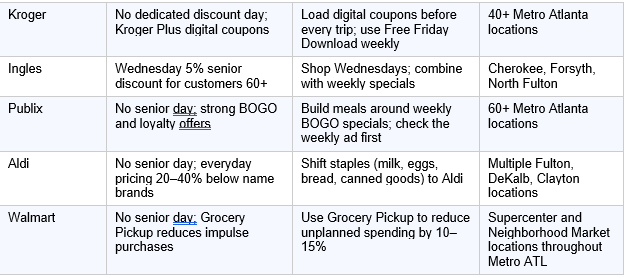
Most Atlanta seniors know that grocery store discounts exist. Far fewer actually plan their shopping around them. The difference between occasionally using a discount and strategically scheduling grocery trips around discount days can add $30 to $60 per month for a typical Atlanta senior household.
The Kroger Plus Card Deep Dive
Kroger is the dominant grocery chain in Metro Atlanta with more than 40 locations across Fulton, DeKalb, Cobb, Clayton, and Gwinnett counties. A properly used Kroger Plus card is one of the most powerful grocery savings tools available to Atlanta seniors. The key habits: load every available digital coupon to the app before each shopping trip, claim the Free Friday Download every Friday (one free item per week adds up to significant savings over a year), and accumulate fuel points that convert to gas savings at Kroger fuel centers and Shell stations across the metro.
The Coupon Stacking Strategy
The maximum grocery savings come from stacking multiple discount layers in the right order: (1) load digital coupons to the loyalty app before shopping, (2) add any applicable manufacturer coupons from Sunday newspaper inserts or apps like Ibotta or Fetch, (3) shop on senior discount day when available, and (4) if applicable, pay with a cashback credit card that is paid in full monthly. This layered approach consistently achieves 25 to 40 percent total savings on a typical Atlanta senior grocery run.
Free Food Programs and Food Banks in Atlanta — More Accessible Than Most Seniors Realize
Food bank and food pantry use is not a last resort. It is a legitimate, available resource that tens of thousands of Metro Atlanta residents use every month, including many who are employed, housed, and managing on a tight fixed income. For Atlanta seniors on Social Security or pension income, supplementing grocery purchases with food bank resources is a smart financial strategy.
Atlanta Community Food Bank
The Atlanta Community Food Bank is the largest food assistance organization in Georgia, distributing food to a 29-county Metro Atlanta area through a network of over 700 partner agencies including food pantries, community kitchens, and senior-specific programs. Most partner agencies require no income verification — you simply visit during their operating hours and receive food.
To find food pantries and programs near any Atlanta-area address, use the Atlanta Community Food Bank partner network locator at acfb.org, or call 404-892-3333.
Senior Farmers’ Market Nutrition Program (SFMNP)
The SFMNP is a federally funded program providing eligible Georgia seniors with seasonal vouchers to purchase fresh fruits, vegetables, honey, and herbs directly from certified farmers at participating markets. Eligibility: age 60 or older with household income at or below 185% of the federal poverty level (approximately $26,000 per year for a single person in 2026). Georgia-eligible seniors typically receive approximately $50 in vouchers per season.
Applications are available through Georgia Division of Aging Services, your local Area Agency on Aging, or the nearest senior center. Apply as early in the program year as possible — availability is subject to annual funding and vouchers are distributed until the supply for that season runs out.
Senior Meal Programs in Fulton County
• Meals on Wheels Atlanta: Delivers hot meals to homebound seniors who cannot safely prepare their own food. Based on need and income — some seniors pay a small fee; others receive meals at no cost. Call (404) 351-3889.
• Fulton County Senior Centers: Most Fulton County senior centers provide daily congregate hot lunch programs at minimal cost ($1 to $3 suggested donation). Transportation assistance is often available. Contact Fulton County Senior Services for locations and schedules.
• Atlanta Regional Commission CARE Line: (404) 463-3333. Connects seniors and families with the full range of food assistance, meal delivery, and senior center programs available across the Metro Atlanta area.
Strategic Meal Planning and Shopping Habits That Cut the Grocery Bill Without Cutting Nutrition
How you shop matters as much as where you shop. These daily habits produce consistent savings without requiring any new programs, applications, or technology.
Plan Before You Shop
Households with a written meal plan before shopping spend 20 to 25 percent less on groceries than those who shop without one. For an Atlanta senior currently spending $350 per month on groceries, consistent meal planning reduces that to approximately $260 to $280 without any change in nutrition. The most effective approach is to review the weekly grocery ad before planning meals — build the week’s menu around what is on sale rather than shopping for predetermined recipes. Kroger, Publix, Aldi, and Walmart all release weekly ads online and through their apps on Wednesdays.
The Protein Shift Strategy
Protein is the most expensive grocery category for most Atlanta seniors. Shifting one or two protein sources per week from meat to legumes — dried beans, lentils, or canned chickpeas — produces meaningful savings without nutritional compromise. A pound of dried beans costs approximately $1.50 and provides the protein equivalent of $8 to $12 in meat. Canned beans run $0.75 to $1.25 per can. Eggs remain one of the most cost-effective complete protein sources available: a dozen eggs at $3 to $4 provides 12 complete protein servings.
Unit Price Comparison — The Core Shopping Skill
The shelf price of a grocery item is almost meaningless without the unit price — price per ounce, per gram, or per serving — which is displayed in smaller text on the shelf tag. Comparing unit prices rather than package prices consistently finds the better value and reveals that store-brand products are typically 15 to 30 percent cheaper per unit than national brands with comparable quality. Kroger’s Private Selection and Simple Truth lines and Publix’s GreenWise line are both consistently strong store-brand options at Atlanta-area stores.
Reducing Food Waste
The USDA estimates that American households waste 30 to 40 percent of purchased food. For an Atlanta senior spending $350 per month on groceries, $100 to $140 worth of food may be going in the trash. Three practices that dramatically reduce waste: buy fresh produce in smaller quantities for two to three days rather than a full week, store produce correctly (not everything belongs in the refrigerator — tomatoes, bananas, and many fruits prefer room temperature), and plan a “use it up” meal the day before each grocery trip to clear remaining perishables.
The nutritious eating myth: The most nutritious foods available — eggs, dried legumes, frozen vegetables, seasonal produce, whole grains, and canned fish — are also among the least expensive items in any Atlanta grocery store. A week of balanced, nutritious meals built around eggs, lentils, frozen broccoli, oats, and in-season produce can cost $40 to $60 for a single Atlanta senior while meeting all primary nutritional needs.
Additional Atlanta Resources That Free Up Money for Food
Reducing non-grocery costs directly increases the money available for food. These programs serve Atlanta seniors and are often unclaimed.
Utility Assistance That Frees Grocery Budget
Georgia’s Low Income Home Energy Assistance Program (LIHEAP) helps qualifying seniors pay heating and cooling bills — directly freeing $50 to $150 per month that can go toward groceries. In Atlanta’s climate, summer cooling and winter heating costs are a significant budget pressure. Apply through Georgia DFCS or the Atlanta Community Action Authority. The Georgia LIHEAP utility assistance program application is available through dfcs.georgia.gov.
Prescription Savings That Free Grocery Budget
For many Atlanta seniors, high prescription co-pays are the primary driver of grocery budget compression. GoodRx, Mark Cuban’s Cost Plus Drugs, and Medicare Extra Help (LIS) can reduce prescription costs by 30 to 80 percent. The Medicare Extra Help program specifically serves low-income Medicare beneficiaries with significantly reduced prescription drug costs — freeing that saved amount directly for food.
AARP BenefitsCheckUp — Find Everything You Qualify For
The AARP BenefitsCheckUp tool to find all benefit programs for Atlanta seniors at benefitscheckup.org is a free online screening tool that identifies every benefit program a specific senior may qualify for — not just food assistance but also utility assistance, healthcare, housing, and transportation programs. This single tool can uncover multiple previously unknown benefits in a single 15-minute session. It is free to use and requires no personal account.
Church and Community Pantries Throughout Fulton County
Beyond the Atlanta Community Food Bank network, most Atlanta-area churches and community organizations operate food pantries or provide food assistance to seniors. These often have the least formal requirements and the most personalized service. Contact local churches directly or ask at your nearest Fulton County senior center for a current list of community pantries in your specific neighborhood.
Dollar Store Grocery Strategy
Dollar Tree and Dollar General carry a specific range of shelf-stable grocery items — canned goods, pasta, seasoning, condiments, and drinks — at prices that regularly beat major grocery chains on those categories. As a supplemental stop for shelf-stable items rather than a full grocery solution, Dollar Tree and Dollar General can reduce the monthly grocery bill by $15 to $30 for Atlanta seniors who shop them strategically. Dollar General’s DG Digital Coupons app adds additional discounts on top of everyday low prices.
Frequently Asked Questions: Saving Money on Groceries for Atlanta Seniors (2026)
These are the questions Atlanta seniors ask most often about grocery savings, SNAP, and food assistance programs.
Q: What is the income limit for SNAP benefits for seniors in Georgia in 2026?
Georgia seniors age 60 and older are exempt from the standard gross income test for SNAP. Only net income after deductions is evaluated. For a single-person senior household, net income must be at or below 100% of the federal poverty level after deductions. Importantly, seniors can deduct out-of-pocket medical expenses above $35 per month, excess shelter costs, and a standard utility deduction — meaning many seniors whose gross income appears to exceed limits actually qualify once deductions are applied. Never assume ineligibility without verifying at gateway.ga.gov or calling Georgia DFCS at 1-877-423-4746.
Q: Does Kroger have a senior discount day in Atlanta?
Kroger does not currently offer a dedicated weekly senior discount day at most Metro Atlanta locations. However, Kroger’s loyalty program through the Kroger Plus card is one of the most powerful grocery savings tools available to Atlanta seniors, providing digital coupons, a weekly Free Friday Download, weekly specials, and fuel point accumulation. Consistently loading digital coupons before each shopping trip typically produces savings equivalent to or greater than a formal percentage discount day.
Q: How do I find food pantries near me in Atlanta?
The Atlanta Community Food Bank’s partner agency locator at acfb.org is the most comprehensive tool for finding food assistance near any Atlanta-area address. Enter your zip code to find the nearest partner agencies, their hours, and what they offer. You can also call the Atlanta Community Food Bank at 404-892-3333. Most partner agencies do not require income verification or documentation — you simply visit during operating hours and receive food.
Q: What is the Senior Farmers’ Market Nutrition Program and how do I apply in Georgia?
The SFMNP provides eligible seniors (age 60+, income at or below 185% of the federal poverty level) with seasonal vouchers to purchase fresh fruits, vegetables, honey, and herbs at participating farmers’ markets and certified farm stands. Georgia vouchers are typically worth approximately $50 per season. To apply, contact Georgia Division of Aging Services, your local Area Agency on Aging, or your nearest senior center. Apply as early in the program year as possible since funds are limited and distributed on a first-come basis.
Q: Is Aldi cheaper than Kroger and Publix for Atlanta seniors?
Yes, in most categories. Independent grocery price comparisons consistently find Aldi’s everyday prices 20 to 40 percent lower than comparable name-brand products at Kroger and Publix. Aldi’s private label products match or exceed national brand quality at significantly lower prices. For Atlanta seniors who can work with limited brand selection, shifting staples — milk, eggs, bread, pasta, canned goods, frozen vegetables — to Aldi can save $40 to $80 per month on those categories alone. Aldi does not offer senior discount days but their everyday pricing consistently achieves greater savings.
Q: Can I use SNAP at farmers’ markets in Atlanta?
Yes. SNAP EBT cards are accepted at many Metro Atlanta farmers’ markets. Georgia also participates in the Double Up Food Bucks program, which matches SNAP spending on fresh Georgia-grown produce dollar-for-dollar at participating markets — effectively doubling purchasing power on fruits and vegetables. Freedom Farmers Market in Atlanta is among participating locations. Check doubleupgeorgia.org for the current list of participating markets and their schedules.
Q: What is the fastest way for an Atlanta senior to start saving on groceries today?
Three actions that can be completed today with no waiting period: First, download the Kroger or Publix app and clip all available digital coupons before your next shopping trip — this alone typically saves $10 to $25 per trip. Second, visit the AARP BenefitsCheckUp tool at benefitscheckup.org to screen for SNAP eligibility and other food assistance programs you may qualify for in approximately 15 minutes. Third, call the Atlanta Community Food Bank at 404-892-3333 to find the nearest food pantry that can supplement your grocery purchases at no cost. These three steps together can produce meaningful savings within the same week.
Q: Are there free meal programs for Atlanta seniors who can’t cook?
Yes. Meals on Wheels Atlanta delivers hot, nutritious meals to homebound seniors who cannot safely prepare their own food. Call (404) 351-3889 to inquire about eligibility and scheduling. Fulton County senior centers also provide congregate lunch programs with transportation assistance available. Contact the Atlanta Regional Commission CARE line at (404) 463-3333 to be connected with the specific program and location nearest you based on your address.
Final Thoughts: The $100+ in Savings Is There — You Just Have to Claim It
Knowing how to save money on groceries as an Atlanta senior is not about clipping coupons for 20 hours a week or changing everything about how you eat. It is about knowing which programs exist, which stores offer the best value for your specific shopping patterns, and which free resources in your specific Fulton County neighborhood can supplement what you purchase.
SNAP alone can put $100 to $292 per month back in your pocket. The Atlanta Community Food Bank can supplement your pantry with no cost and no judgment. The SFMNP can provide free seasonal produce at your local farmers’ market. And the shopping habits in this guide can trim another $50 to $80 off the monthly bill without making your meals any less satisfying.
Start with one step. Check your SNAP eligibility. Load your Kroger coupons. Call the food bank. Every one of those actions is free and takes less than 30 minutes.
Groceries Are Just One Piece. ATL Home Help Solutions Helps Atlanta Seniors See the Full Picture.
Saving money on groceries is important — but it’s one piece of a larger financial picture that many Atlanta seniors are managing under real pressure. If food costs, property taxes, utility bills, and home maintenance are all compressing a fixed income that isn’t keeping pace, the problem isn’t just which grocery store to use. I’m Gerald Harris, founder of ATL Home Help Solutions. I work with Atlanta and Fulton County senior homeowners who are trying to make their housing situation and their overall financial situation more sustainable. Whether that means identifying programs you qualify for, understanding what your property is worth, or exploring whether your current housing still makes sense for where you are in life — I can help you see the full picture.
No judgment. No pressure. Just honest guidance.
📞 Call or Text: 404-913-7086 📧 Email: gerald@atlhomehelp.com
Visit ATL Home Help Solutions — Contact Gerald Harris — No pressure. No judgment. Just honest local guidance.