


You’re 69 years old. You’ve owned your Sandy Springs home for 31 years, and your equity is somewhere around $280,000. Your Social Security barely covers your property taxes and insurance. You’ve heard about reverse mortgages for years and wondered whether they’re the financial lifeline they sound like — or the trap your neighbor warned you about. The honest answer is: they can be either, depending entirely on your specific situation.
The reverse mortgage pros and cons are real on both sides. This is not a product that deserves either the enthusiasm of late-night television advertising or the blanket skepticism of financial commentary that has never worked with Atlanta homeowners who genuinely need an equity access strategy. It deserves honest, balanced analysis based on your specific circumstances, your specific property, and your specific goals.
Metro Atlanta’s real estate market has created a generation of senior homeowners who are equity-rich and cash-poor. Many have owned their homes for 20 to 40 years in neighborhoods like Cascade Heights, College Park, East Point, Sandy Springs, and Southwest Atlanta, where values have appreciated dramatically. A $310,000 home owned free and clear is a powerful financial asset — and a reverse mortgage is one of several tools for accessing that asset. This guide gives you everything you need to evaluate whether it is the right tool for your situation.
What Is a Reverse Mortgage and How Does It Work in Georgia?
A Home Equity Conversion Mortgage (HECM) is a federally insured loan product administered under HUD’s FHA program that allows homeowners age 62 and older to convert a portion of their home equity into accessible funds — without making monthly mortgage payments. It is the only reverse mortgage product insured by the federal government.
When the Loan Becomes Due
The loan is not due until: the last borrower permanently moves out of the home, the home is sold, the last borrower passes away, or the borrower fails to meet ongoing obligations. Those obligations are: paying property taxes on time, maintaining homeowner’s insurance, and keeping the property in reasonable condition. Failure on any of these triggers default.
How the Loan Amount Is Calculated
Three factors determine the Principal Limit — the maximum amount you can access. First, the age of the youngest borrower or eligible non-borrowing spouse: older borrowers access a higher percentage of their equity. Second, current interest rates: lower rates allow access to more equity. Third, the home’s appraised value up to the 2026 FHA lending limit.
A practical Atlanta example: a 72-year-old homeowner with a $320,000 Fulton County home and no existing mortgage might access approximately $165,000 to $195,000. A 78-year-old in the same home might access $185,000 to $210,000. The older the borrower, the higher the accessible percentage.
The Four Disbursement Options
• Lump sum: Single upfront payment — available on fixed-rate HECMs only.
• Line of credit: Draw on available funds as needed. The unused portion of the line of credit grows over time — one of the most powerful and underappreciated features of the HECM product.
• Monthly term payments: Fixed monthly payments for a defined number of months.
• Monthly tenure payments: Fixed monthly payments for as long as the borrower lives in the home.
The Non-Recourse Protection
The HECM is a non-recourse loan. The lender cannot pursue the borrower or the estate for more than the home’s value at the time of repayment. If the loan balance exceeds the home’s value when the loan comes due, the FHA insurance fund covers the difference. Heirs who want to keep the home must pay off the loan balance or 95% of the appraised value, whichever is less.
HUD Counseling Requirement
Federal law requires every HECM applicant to complete HUD-approved reverse mortgage counseling before applying. This is mandatory, costs approximately $125, and is one of the most genuinely useful steps in the process — the counselor explains all terms and costs with no sales pressure. The CFPB guide to understanding reverse mortgages provides additional detail on how HECM loans are structured and what federal consumer protections apply.
Georgia-specific note: Property tax delinquency is one of the leading causes of reverse mortgage default in Georgia. Atlanta’s rising property tax environment makes this the most critical ongoing obligation for any Fulton County homeowner considering a reverse mortgage. Applying for all available senior property tax exemptions BEFORE applying is non-negotiable.
The Real Pros of a Reverse Mortgage for Atlanta Seniors
The benefits of a reverse mortgage are real and meaningful for the right situation. This section provides an honest accounting of when a HECM is a genuinely powerful financial tool for Atlanta homeowners over 62.
Pro 1: Access Equity Without Selling the Home
For long-term Atlanta homeowners who are equity-rich but cash-poor, a reverse mortgage converts accumulated equity into usable financial resources without forcing a sale. Many Atlanta seniors own homes worth $250,000 to $450,000 outright but live on Social Security income of $1,200 to $1,800 per month. Particularly in neighborhoods like Cascade Heights, Southwest Atlanta, East Point, and College Park where generational homeownership is common, this gap between asset wealth and income is exactly what a reverse mortgage is designed to address.
Pro 2: No Monthly Mortgage Payment
Eliminating a monthly mortgage payment — or never creating one in the first place when refinancing into a HECM from a traditional mortgage — can immediately improve monthly cash flow by $800 to $2,000. Those funds can be redirected to healthcare, home care, home maintenance, or quality of life. The obligation to pay property taxes, insurance, and HOA fees remains unchanged.
Pro 3: The Growing Line of Credit
The unused portion of a HECM line of credit grows at the same rate as the loan’s interest rate. A $150,000 line of credit established at 66 grows automatically over time — a borrower who establishes the line and does not draw on it for 10 years may find a significantly larger available credit at 76 when it is actually needed. In Atlanta’s appreciating market, establishing a HECM line of credit early while maintaining the home is a legitimate long-term financial planning strategy.
Pro 4: Non-Recourse Loan Protection
The loan cannot exceed the home’s value at repayment. Heirs are fully protected from owing more than the home is worth. FHA insurance covers any shortfall. For Atlanta seniors concerned about leaving debt to their children, this protection is meaningful and legally binding.
Pro 5: Tax-Free Proceeds
Reverse mortgage proceeds are not considered income by the IRS and are not taxable. They also do not affect Social Security or Medicare benefits. For Atlanta seniors on fixed incomes who need to supplement without triggering tax consequences, this is a significant and genuine advantage.
Pro 6: Disbursement Flexibility
The ability to combine a lump sum for immediate needs — a stair lift and bathroom conversion, paying off an existing mortgage balance — with a line of credit for ongoing flexibility and monthly payments for income supplementation makes the HECM adaptable to a wide range of Atlanta senior financial situations.
The Real Cons of a Reverse Mortgage — What Atlanta Homeowners Must Understand
The risks are real, specific, and have ended badly for Atlanta homeowners who didn’t fully understand what they were committing to. This section is not fear-mongering. It is an honest accounting of when a reverse mortgage creates serious problems.
Con 1: The Loan Balance Grows Over Time
Because interest accrues monthly and is added to the loan balance rather than paid currently, a reverse mortgage balance can grow substantially. A $150,000 initial draw at a 7% interest rate grows to approximately $295,000 in 10 years and $580,000 in 20 years. For Atlanta homeowners in appreciating markets, rising home values may partially offset this — but appreciation is not guaranteed, and heirs who want to keep the home may face a significantly larger payoff obligation than anticipated.
Con 2: Significant Upfront Costs
HECM reverse mortgages carry upfront costs that are typically financed into the loan balance from day one:
• FHA mortgage insurance premium (MIP): 2% of appraised value upfront, then 0.5% annually on the outstanding balance
• Origination fee: up to $6,000 or 2% of the first $200,000 of home value, whichever is greater
• Closing costs: appraisal, title insurance, attorney fees — typically $3,000 to $6,000 in Atlanta
• Total upfront cost financed into the loan at closing: often $12,000 to $20,000 or more
For homeowners who may only remain in the home for three to five more years, these costs may not be recoverable through the product’s benefits.
Con 3: Default Risk From Tax and Insurance Failure
The single most common cause of reverse mortgage default in Georgia is failure to maintain property taxes and homeowner’s insurance. An Atlanta homeowner who takes a lump sum, spends it, and then cannot pay a $4,500 annual property tax bill loses the home to reverse mortgage foreclosure — a devastating outcome that eliminates all remaining equity. Atlanta and Fulton County’s rising property tax environment makes this risk particularly acute. This is why applying for every available senior exemption before entering a reverse mortgage is not optional advice — it is essential protection.
Con 4: Reduces the Estate
A reverse mortgage consumes home equity over time. The longer the borrower lives and the more they draw, the less equity remains for heirs. In historically Black Atlanta neighborhoods where generational homeownership is deeply significant — Cascade Heights, Vine City, Pittsburgh, Southwest Atlanta — this concern is not merely financial. It is cultural, familial, and connected to decades of wealth-building that a reverse mortgage can accelerate the erosion of.
Con 5: Occupancy Requirement and Long-Term Care Risk
The home must remain the borrower’s primary residence. If the borrower moves to an assisted living facility or memory care for more than 12 consecutive months, the reverse mortgage becomes due immediately. For Atlanta seniors who may eventually need long-term care, this can create a forced sale under time pressure. Single elderly homeowners with no co-borrower on the loan face this risk most directly.
Con 6: Complexity and Potential for Misuse
The complexity of reverse mortgage terms creates opportunity for misunderstanding and, historically, for predatory practices. Atlanta seniors should be extremely cautious about anyone who encourages using reverse mortgage proceeds to purchase annuities, invest in financial products, or fund a family member’s real estate purchase. These are documented reverse mortgage abuse patterns. The mandatory HUD counseling requirement exists precisely because of this history.
The ACV roof connection: Many Atlanta seniors considering a reverse mortgage have aging roofs that carriers have shifted to actual cash value (ACV) settlement. If a roof claim pays $4,000 on a $22,000 replacement, the shortfall must come from somewhere. A reverse mortgage that is later depleted covering uninsured home maintenance is a pattern that ends in default. Address roof age and coverage type before entering a reverse mortgage.
Who Should and Should Not Get a Reverse Mortgage in Atlanta
The pros and cons are clear. The question is: which column weighs more for your specific situation? Here is the honest framework for Atlanta senior homeowners evaluating this decision.
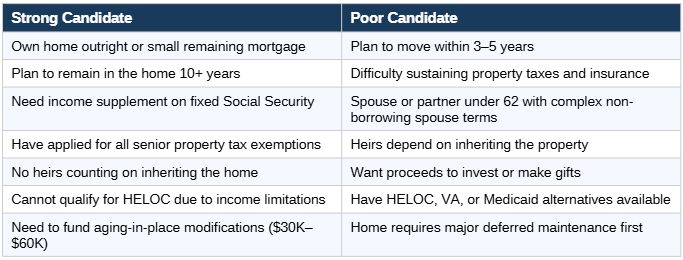
The Alternative Comparison Every Atlanta Homeowner Should Run
Every reverse mortgage decision should be compared honestly against these alternatives before committing:
• Selling and downsizing: A voluntary as-is sale in Atlanta’s market can generate $200,000 to $400,000 in immediate equity proceeds, fund a move to a lower-maintenance property, and eliminate all the obligations that cause reverse mortgage default.
• HELOC: For homeowners with sufficient income to qualify, a Home Equity Line of Credit has lower costs and more flexibility. The risk is requiring monthly payments.
• Georgia Medicaid home care programs: CCSP and SOURCE can fund in-home care without touching equity for qualifying seniors. Apply before assuming a reverse mortgage is necessary to fund care.
• VA Aid and Attendance: For qualifying veterans and surviving spouses, this benefit can provide $1,100 to $2,300+ per month for home care without any equity transaction.
ATL Home Help Solutions provides free no-obligation Atlanta property assessments for homeowners evaluating a reverse mortgage. Knowing the real current market value of your specific property is the starting point for every calculation that follows.
Steps Atlanta Homeowners Over 62 Should Take Before Getting a Reverse Mortgage
If you believe a reverse mortgage is worth serious consideration, here are the specific steps that protect Atlanta homeowners from the most common and most costly mistakes.
1. Apply for all Fulton County senior property tax exemptions first: Do this before the reverse mortgage application. Qualifying seniors age 62 and older can reduce annual property tax liability by $1,000 to $2,500 or more through the homestead exemption, school tax exemption, and floating homestead value freeze. Apply through the Fulton County Tax Commissioner’s senior exemption portal before April 1 of the tax year. Lower annual tax obligations directly reduce the primary default risk of the reverse mortgage.
2. Complete HUD-approved reverse mortgage counseling: Required by federal law before any HECM application. Cost: approximately $125. The counselor must be HUD-approved and completely independent of any lender. Find one through the HUD-approved reverse mortgage counselor locator near Atlanta. Bring a trusted adult child or advisor if possible. Take notes on the full cost and benefit breakdown the counselor provides.
3. Get a realistic property value assessment: The appraised value determines how much you can access. An independent assessment before applying prevents surprises and helps you evaluate whether the reverse mortgage produces enough value to justify the costs. ATL Home Help Solutions provides this assessment at no obligation.
4. Compare at least three HECM lenders: Interest rates, origination fees, and service fees vary among approved lenders. The National Reverse Mortgage Lenders Association directory of approved lenders lists HUD-approved lenders nationwide. Never use a lender who contacts you unsolicited or who combines a reverse mortgage pitch with a financial product sale.
5. Evaluate disbursement structure carefully: The line of credit offers the most flexibility and the growing feature. Monthly payments offer predictable income supplementation. A lump sum is appropriate only for specific, defined uses like paying off an existing mortgage or funding targeted home modifications — lump sum spending without a plan is the pattern most associated with reverse mortgage regret and eventual default.
6. Involve family and review with an attorney: Adult children and other heirs who may be affected should participate in the conversation. A Georgia-licensed elder law or real estate attorney should review the final loan documents before signing. The complexity of HECM terms warrants independent professional review.
Frequently Asked Questions: Reverse Mortgages for Atlanta Homeowners in 2026
These are the questions Atlanta homeowners over 62 ask most often when evaluating a reverse mortgage. Each answer reflects federal HECM rules and Georgia-specific context.
Q: What is the age requirement for a reverse mortgage in Georgia in 2026?
The minimum age is 62 for the primary borrower. If there is a non-borrowing spouse under 62, specific HUD protections apply — they can remain in the home after the borrower passes away or moves to a care facility, but they cannot receive additional loan proceeds. For Atlanta couples where one spouse is significantly younger than 62, this is one of the most important planning considerations before applying. The disbursement amount is also reduced when a non-borrowing spouse under 62 is present, since the calculation must account for their potentially longer tenure in the property.
Q: How much money can I get from a reverse mortgage on my Atlanta home in 2026?
The amount depends on your age, the current interest rate, and your home’s appraised value up to the 2026 FHA lending limit. Borrowers in their early 70s typically access 45% to 55% of their home’s appraised value. Borrowers in their late 70s and older typically access 55% to 65% or more. On a $320,000 Atlanta home with no existing mortgage, a 74-year-old might access approximately $155,000 to $190,000. The exact figure requires a formal calculation from a HUD-approved lender or counselor using current interest rates.
Q: Do I lose ownership of my home with a reverse mortgage?
No. You retain full ownership and title to your home throughout the life of the reverse mortgage. The lender holds a lien on the property — exactly as a traditional mortgage does — but you remain the legal owner. You can sell the home at any time, pay off the reverse mortgage balance from the proceeds, and keep any remaining equity. Many Atlanta homeowners confuse a reverse mortgage with a deed transfer. It is not. You are borrowing against your equity, not transferring it.
Q: What happens to my reverse mortgage when I pass away?
When the last borrower passes away, the loan becomes due and payable. Your heirs have three options: pay off the reverse mortgage balance and keep the home, sell the home and use the proceeds to pay off the balance and keep any remaining equity, or allow the lender to sell the home to satisfy the debt. Because of the non-recourse protection, heirs will never owe more than the home’s appraised value. If the loan balance exceeds that value, FHA insurance covers the difference. Heirs typically have 6 months to make a decision, with possible extensions to 12 months if they are actively working to sell or refinance.
Q: Can I get a reverse mortgage if I still have a mortgage on my Atlanta home?
Yes — and eliminating an existing mortgage is one of the most common uses of a reverse mortgage. If you have a remaining mortgage balance, the reverse mortgage proceeds must first be used to pay it off. The remaining available proceeds are then yours to use as you choose. For Atlanta homeowners still carrying a mortgage in their late 60s or 70s who struggle with monthly payments, converting to a reverse mortgage eliminates that payment obligation immediately. The tradeoff is that the existing balance is added to the reverse mortgage loan, reducing the equity available for other uses.
Q: Will a reverse mortgage affect my Social Security or Medicare benefits?
No. Reverse mortgage proceeds are loan disbursements, not income, and they do not affect Social Security or Medicare eligibility or payment amounts. However, if you receive Medicaid or Supplemental Security Income (SSI), any reverse mortgage proceeds that you do not spend in the month they are received count as a resource in the following month — potentially affecting Medicaid or SSI eligibility. Atlanta seniors who receive Medicaid-funded home care programs such as CCSP or SOURCE should consult a Georgia-licensed elder law attorney before accessing reverse mortgage funds to avoid unintended disruption of benefits they depend on.
Q: What are the most common reasons reverse mortgages go wrong for Georgia homeowners?
Three patterns account for the majority of Georgia reverse mortgage failures. First, failure to maintain property taxes and homeowner’s insurance — Atlanta’s rising property tax environment makes this the most urgent risk for Fulton County homeowners. Second, taking a lump sum without a specific, defined plan and spending the proceeds without creating long-term financial benefit. Third, entering the product with less than five to seven years of anticipated remaining occupancy, meaning the significant upfront costs are never recovered through the product’s benefits. All three are preventable with planning before signing.
Q: Is a reverse mortgage better than selling my Atlanta home?
It depends entirely on your goals and your specific situation. A reverse mortgage is generally better than selling if you want to remain in the home long-term, your home provides stability and community, and you have a sustainable plan for the ongoing obligations. Selling is generally better than a reverse mortgage if your care needs are likely to require a facility within a few years, the home requires significant maintenance that will be difficult to sustain, or a sale would generate equity proceeds that fund a better living situation. Many Atlanta seniors find that a voluntary sale — generating $200,000 to $400,000 in lump-sum equity — and a move to a lower-maintenance property produces better long-term outcomes than a reverse mortgage on a home that no longer fits their life. ATL Home Help Solutions can help you run an honest side-by-side comparison for your specific property and situation.
Final Thoughts: A Reverse Mortgage Is a Tool, Not a Solution
The reverse mortgage pros and cons are genuinely balanced — which is exactly why the decision requires serious, personalized evaluation rather than a blanket endorsement or a blanket rejection. For the right Atlanta homeowner in the right situation, a HECM is a powerful financial tool that can fund years of comfortable, sustainable aging in place. For the wrong situation, it is an expensive product that accelerates equity erosion and creates default risk.
The Atlanta homeowners who use reverse mortgages successfully share three characteristics: they understood the full costs and obligations before signing, they applied for every available tax exemption and senior benefit before entering the loan, and they matched the disbursement structure to a specific, sustainable plan. Those who struggle share one characteristic: they signed without fully understanding what they were committing to. This guide exists so you don’t make that mistake.
Evaluating a Reverse Mortgage on Your Atlanta Property? Let’s Start With the Real Numbers.
A reverse mortgage is one of the most significant financial decisions an Atlanta homeowner can make. Getting it right starts with understanding exactly what your specific property is worth, what you can realistically access, and whether a reverse mortgage is the best tool for your situation — or whether selling, a HELOC, or another path produces a better outcome. I’m Gerald Harris, founder of ATL Home Help Solutions. I work with Atlanta and Fulton County senior homeowners every day who are evaluating exactly this kind of decision. I can give you a no-obligation property assessment and walk through what every realistic option looks like for your specific situation.
No sales pitch. No agenda. Just honest guidance.
📞 Call or Text: 404-913-7086 📧 Email: gerald@atlhomehelp.com
Visit ATL Home Help Solutions — Contact Gerald Harris — No pressure. No judgment. Just honest local guidance.