


Georgia homeowners insurance rates have climbed significantly in 2024 and 2025. If your premium renewal came in 20% to 40% higher than last year, you are not imagining it — and you are not alone. The combination of severe weather events across the Southeast, rising construction costs, and insurance carrier pullbacks from high-risk markets has pushed average Georgia homeowners insurance premiums up sharply. The question of who has the cheapest homeowners insurance in Georgia has never been more important — or more complicated — to answer.
As a real estate consultant working with Atlanta and Fulton County homeowners every day, I see the financial impact of both inadequate insurance and overpriced insurance. Homeowners who are underinsured discover it at the worst possible moment — after a major loss. Homeowners who are overpaying have been making an avoidable financial mistake for years. Neither outcome is acceptable when the right information is available.
This guide gives you that information: who is currently competitive in Georgia’s homeowners insurance market, what factors are actually driving your specific premium, the costly mistakes Atlanta homeowners make far too often, a practical playbook for reducing your premium without sacrificing protection, and the Atlanta-specific issues that most national insurance articles completely miss.
Why Georgia Homeowners Insurance Rates Are Rising — And Who’s Still Competing
Georgia’s homeowners insurance market has undergone significant disruption in 2024 and 2025. Understanding why rates are rising is the first step toward knowing how to navigate the market effectively.
What Is Driving Georgia Premium Increases
• Severe weather frequency: Georgia has experienced increased frequency of hail storms, high-wind events, and flooding across Metro Atlanta and the surrounding counties. Insurance carriers use rolling 5-year loss data to set premiums — and recent years have been expensive.
• Construction cost inflation: Replacing a storm-damaged roof in Atlanta that cost $12,000 in 2019 now costs $18,000 to $24,000. The same inflation applies to every covered repair. When replacement costs rise, so do the premiums that fund them.
• Reinsurance cost pass-through: The reinsurance market — the insurance that insurance companies themselves purchase — has experienced significant rate increases. Georgia carriers are passing these costs directly to policyholders.
• Carrier market exits: Several major carriers have reduced their Georgia exposure or stopped writing new policies in specific ZIP codes, reducing competition and pushing remaining homeowners toward fewer options.
Who Is Still Actively Competing in Georgia’s Market in 2026
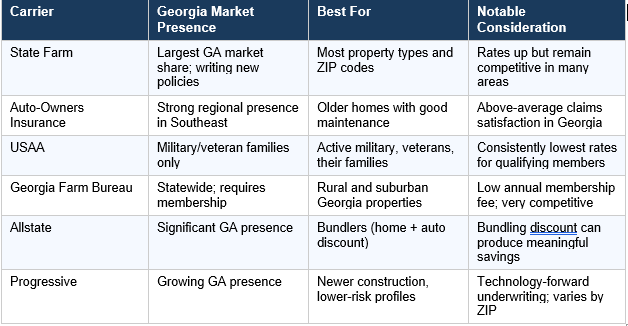
The ZIP code reality: Insurance pricing in Metro Atlanta is highly granular. The same home in Buckhead, College Park, and Smyrna can carry meaningfully different base rates with the same carrier. A carrier that is cheapest in one ZIP code may not be cheapest two miles away. Always get local quotes — national rate comparisons are not reliable for Atlanta homeowners.
The 7 Factors That Determine Your Georgia Homeowners Insurance Rate
Finding the cheapest homeowners insurance in Georgia requires understanding what is actually driving your premium. Two neighbors on the same street with similar homes can pay very different rates because of differences in these seven factors. Knowing them is the key to targeting the right reductions.
1. Roof Age and Condition
The single most impactful factor in Georgia homeowners insurance pricing after location. Most Georgia carriers apply surcharges or coverage restrictions for roofs over 15 to 20 years old. Many will not issue or renew policies on homes with roofs over 20 years old without an inspection or replacement. A new roof can reduce a Georgia homeowners insurance premium by $300 to $800 per year while also eliminating actual cash value (ACV) coverage restrictions that can devastate a claim payout. Atlanta’s in-town neighborhoods — East Atlanta Village, West End, Grant Park, Decatur, Inman Park — have significant concentrations of pre-1950 homes where this issue is most acute.
2. Location and ZIP Code
Carriers use ZIP code-level data to assess crime statistics, weather exposure, and fire protection proximity. Metro Atlanta ZIP codes with higher burglary rates and storm exposure carry higher base rates. Distance from fire stations and hydrants also affects premiums — urban Atlanta homes close to fire resources sometimes benefit, while rural and semi-rural Fulton County properties pay more.
3. Construction Type and Home Age
Brick construction typically carries lower fire and wind damage rates than wood frame. Pre-1978 homes may face surcharges for older electrical systems (knob-and-tube or aluminum wiring) and galvanized plumbing. Atlanta’s large stock of craftsman and bungalow homes from the 1920s through 1950s are frequently flagged for electrical and plumbing concerns during underwriting review.
4. Dwelling Coverage Amount
Your dwelling coverage limit should be set at the estimated replacement cost of the structure — not market value, not purchase price, not tax assessed value. Underinsurance is the single most financially devastating homeowners insurance mistake in Georgia. A home with a $450,000 market value may have a $280,000 or $380,000 replacement cost depending on construction type and finish level. Construction cost inflation in Atlanta over the past five years means replacement cost estimates from 2019 or 2020 are now dramatically understated.
5. Deductible Level
Raising your standard deductible from $1,000 to $2,500 can reduce Georgia premiums by 15 to 25 percent. But the wind/hail deductible — often a separate deductible expressed as 1% to 5% of dwelling coverage — is a different calculation. A $3,000 to $10,000 separate out-of-pocket cost for storm damage claims deserves serious consideration before raising your deductible structure.
6. Claims History
Georgia carriers use the CLUE (Comprehensive Loss Underwriting Exchange) report to see your claims history for the past 7 years, including claims on previous properties. A single water damage claim can increase premiums significantly for years. The property’s claims history also matters — buyers inheriting a home or purchasing a property with prior water damage claims should check the CLUE report before closing.
7. Credit Score
Georgia allows insurance carriers to use credit-based insurance scores in homeowners insurance pricing. Homeowners with lower credit scores can pay 20 to 50 percent more for identical coverage than those with strong credit. This is one of the most impactful and least-discussed factors in Georgia insurance pricing — and one of the few that is fully within the homeowner’s control to improve over time. For more information on how Georgia regulates insurance pricing and your rights as a policyholder, the Georgia Office of Insurance consumer guide to homeowners insurance at oci.georgia.gov covers carrier licensing, consumer complaint resolution, and policyholder protections.
The Costliest Homeowners Insurance Mistakes Georgia Homeowners Make
The search for cheap homeowners insurance is worthwhile — but certain shortcuts cost far more than they save. These are the mistakes most commonly seen among Atlanta-area homeowners that leave them either overpaying or dramatically underprotected.
Mistake 1: Insuring for Market Value Instead of Replacement Cost
The most financially devastating mistake in Georgia homeowners insurance. Market value includes land, which cannot be damaged by fire or storm. Replacement cost is what it would cost to rebuild the structure from scratch at current labor and material prices — which is the only number that matters for your coverage.
In Atlanta’s in-town neighborhoods, land value can represent 30 to 50 percent of total market value. A home with a $450,000 market value may need only $290,000 in dwelling coverage — or $380,000 in dwelling coverage depending on construction. Getting this number right, from an independent replacement cost estimator or a knowledgeable contractor, is the most important step in setting your coverage correctly.
Mistake 2: Dropping Liability Coverage to Save on Premium
Reducing personal liability coverage from $300,000 to $100,000 saves approximately $20 to $50 per year on most Georgia policies. For Atlanta homeowners with significant home equity, retirement accounts, or other assets, that $20 in savings creates exposure to lawsuits that could reach hundreds of thousands of dollars. Maintain at least $300,000 in liability coverage and consider an umbrella policy for additional protection. Rental property owners in Atlanta face even greater liability exposure and should never reduce this coverage.
Mistake 3: Not Shopping at Renewal
Many Georgia homeowners set their insurance and never revisit it — paying the renewal premium year after year without getting competing quotes. Carrier pricing changes significantly year over year. The carrier that was cheapest in 2021 may be among the most expensive in 2026. Shopping every two to three years takes under two hours and can produce savings of $400 to $1,200 per year for Atlanta homeowners. The only barrier is inertia.
Mistake 4: Filing Small Claims That Increase Long-Term Premiums
Filing a $1,200 claim for minor water damage may seem straightforward — but the resulting premium increase of $200 to $400 per year for three to five years costs more than the claim paid out. A single water damage claim in Georgia can increase your premium by 15 to 40 percent for multiple policy years. Before filing any claim under $3,000, call the carrier first, ask about the premium impact, and calculate whether self-paying produces better financial results over three years. Treat insurance as catastrophic protection, not a home maintenance fund.
Mistake 5: Having No Flood Coverage in Atlanta
Standard homeowners insurance in Georgia does not cover flood damage under any circumstances. Metro Atlanta experiences flash flooding that affects properties well outside traditional FEMA flood plains — particularly near Peachtree Creek, the South River, Utoy Creek, Nancy Creek, and other urban waterways. Atlanta homeowners who discover flood damage is excluded after a major rainfall event face some of the most financially devastating uninsured losses in Georgia real estate. The National Flood Insurance Program and private flood insurance options are both available for Georgia homeowners.
Mistake 6: Skipping the Sewer and Water Backup Endorsement
Standard Georgia homeowners policies do not cover sewer or water backup damage. An endorsement typically costs $50 to $150 per year and covers damage from backed-up drains, sewers, and sump pump overflow. In Atlanta’s aging urban sewer infrastructure — particularly in older in-town neighborhoods where cast-iron sewer lines are deteriorating — this is a common and expensive claim type. The endorsement cost relative to a single backup event is one of the most cost-effective coverage additions available.
The coverage gap that surprises Atlanta homeowners most: ACV (Actual Cash Value) roof coverage. If your carrier has shifted your roof to ACV settlement rather than replacement cost coverage — which many Georgia carriers have done quietly for roofs over 15 years old — a $22,000 roof replacement claim may pay only $5,000 after depreciation. Check your policy declarations page for roof settlement method right now.
How to Actually Get the Cheapest Homeowners Insurance in Georgia — 7 Proven Steps
Understanding what drives rates and what mistakes to avoid is the foundation. Here is the specific action plan for reducing your Georgia homeowners insurance premium without sacrificing the coverage you actually need.
1. Get at least three quotes with identical coverage: The most important word is identical. Comparing policies with different dwelling coverage amounts, different liability limits, or different deductibles produces meaningless comparisons. Use an independent insurance agent who can quote multiple carriers simultaneously.
2. Bundle home and auto insurance: Bundling typically produces discounts of 5 to 20 percent on both policies. For most Atlanta homeowners, bundling with State Farm, Allstate, or Nationwide produces the most consistent bundling discount. Run the full combined premium math — the bundled total should beat the sum of separate lowest-cost policies.
3. Document and report all safety features: Central alarm systems, monitored security systems, deadbolt locks, smoke detectors, and storm shutters all qualify for discounts with most Georgia carriers. The monitoring discount from a professionally monitored security system is typically 5 to 15 percent. Report every qualifying feature to your agent — these discounts are not always automatically applied.
4. Raise your deductible strategically: Raising your standard deductible from $1,000 to $2,500 can reduce your Georgia premium by 15 to 25 percent. Only appropriate if you maintain an emergency fund equal to the higher deductible. Understand your wind/hail deductible separately before making any deductible changes.
5. Address roof age proactively before renewal: If your Atlanta home’s roof is approaching 15 to 18 years old, get it inspected and consider replacement before your next renewal. A new roof eliminates age surcharges, removes ACV restrictions, and qualifies for new-roof discounts. Premium savings over five to seven years can meaningfully offset replacement cost. To verify that any contractor you hire is properly licensed in Georgia, use the Georgia contractor and insurance company license lookup at the Office of Insurance.
6. Improve your credit score: Since Georgia allows credit-based insurance scoring, moving your credit score from the 600s to the 720s can reduce your homeowners insurance premium by 15 to 30 percent over time. Paying down credit card balances, avoiding new accounts before renewal, and correcting credit report errors are the most effective strategies.
7. Ask specifically about claims-free and loyalty discounts: Most Georgia carriers offer premium reductions for policyholders who have been claim-free for three or more years. Loyalty discounts after three to five years without coverage lapses are also available. These are not always automatically applied — ask your agent or carrier directly at every renewal.
What Atlanta Homeowners Specifically Need to Know About Homeowners Insurance in 2026
General guidance about the cheapest homeowners insurance in Georgia misses the issues that are most consequential for Metro Atlanta homeowners specifically. Here is what national articles get wrong about Atlanta’s insurance market.
The Roof Age Crisis in Atlanta’s Older Neighborhoods
In-town Atlanta neighborhoods — East Atlanta Village, West End, Inman Park, Kirkwood, Grant Park, Ormewood Park, and Decatur — contain significant concentrations of pre-1950 craftsman and bungalow homes. Many of these homes had roof replacements in the 2000s and early 2010s, meaning those roofs are now 15 to 20-plus years old. Multiple carriers are non-renewing policies on these homes or quietly shifting to ACV roof coverage rather than replacement cost coverage. A homeowner who experiences a total roof loss under ACV settlement may receive $4,000 toward a $22,000 replacement — with no recourse. Check your current policy’s declarations page for the roof settlement method today.
The Landlord Policy vs. Homeowners Policy Error
Atlanta has one of the highest proportions of investor-owned single-family rentals in the Southeast. A significant number of Atlanta property owners carry a standard HO-3 homeowners policy on properties that have tenants — which is a coverage violation that can result in a full claim denial. Rental properties require a landlord policy (DP-1, DP-2, or DP-3 form). This mistake is particularly common among accidental landlords — former primary residences converted to rentals without updating insurance. If you are renting out any property in Atlanta and your policy is a standard HO-3, this is an urgent correction to make.
Heirs’ Property and Insurance Coverage
Properties with unclear title — heirs’ property situations common in Atlanta’s historically Black neighborhoods — can face difficulty obtaining or maintaining homeowners insurance. Some Georgia carriers will not insure properties with multiple unresolved ownership interests or unclear title chains. A coverage lapse on an inherited heirs’ property creates both uninsured risk and potential mortgage requirement violations. Resolving heirs’ property title clears the path to proper coverage and protects the family’s full investment.
Atlanta’s Underestimated Flood Risk
FEMA flood maps do not fully capture Metro Atlanta’s flash flood risk. Many Atlanta homes outside formal flood zones have flooded during extreme weather events. Properties within 500 feet of Peachtree Creek, Nancy Creek, South River, Utoy Creek, and other urban waterways should seriously consider flood insurance regardless of FEMA zone designation. The National Flood Insurance Program has undergone significant pricing changes under Risk Rating 2.0 that now reflect individual property risk more accurately.
Check your specific property’s flood zone designation using the FEMA flood map service to check your Atlanta property’s flood zone status. And for complete information on policy options and current Georgia rates, the National Flood Insurance Program coverage and rate information for Georgia homeowners at floodsmart.gov is the authoritative resource.
The Georgia FAIR Plan as a Last Resort
If you receive a non-renewal notice from your Georgia carrier, act immediately. Georgia requires insurers to provide at least 45 days written notice of non-renewal. Upon receiving a non-renewal notice, begin shopping with independent agents without delay. If standard market coverage is unavailable for your property, the Georgia FAIR Plan — administered through the Georgia Underwriting Association — provides basic coverage as a last resort. It is significantly more expensive than standard market coverage and provides more limited protection, but it ensures you are not without coverage while continuing to shop.
The Property Tax and Coverage Confusion
Fulton County property tax reassessments have pushed assessed values significantly higher in recent years. Many Atlanta homeowners have increased their dwelling coverage in response to higher assessed values — but this is almost always incorrect. Coverage should be based on replacement cost, not assessed value, not market value. Higher assessed values do not mean higher replacement costs. Review your dwelling coverage limit independently of your tax assessment using a current replacement cost estimate.
Final Thoughts: Cheap Insurance Is Only Valuable If It Actually Pays When You Need It
The answer to who has the cheapest homeowners insurance in Georgia is genuinely not a single carrier. It is the carrier that offers the lowest rate for your specific property, your specific location, your specific risk profile — with coverage that will actually perform when you file a claim. That answer requires getting real quotes with identical coverage, understanding what is driving your current premium, and avoiding the shortcuts that leave Atlanta homeowners underinsured at the worst possible moments.
A homeowners insurance policy is the financial foundation that protects everything else about your Atlanta property — your equity, your personal assets, your housing stability. Get it right, not just cheap.
Questions About Your Atlanta Property’s Insurance, Coverage, or Financial Health?
Homeowners insurance is one of the most important financial protections your Atlanta property has — and one of the most commonly misunderstood. Whether you’re trying to reduce a premium that’s gotten out of control, figuring out what coverage an inherited property actually needs, or trying to understand whether a non-renewal notice means you’re about to be uninsured — these decisions have real financial consequences. I’m Gerald Harris, founder of ATL Home Help Solutions. I work with Atlanta and Fulton County homeowners who are trying to protect what they’ve built. If your insurance situation is connected to a property decision — whether to keep, repair, or sell — I can help you think through it clearly and without pressure.
Protect what you’ve built. Start with the right information.
📞 Call or Text: 404-913-7086 📧 Email: gerald@atlhomehelp.com
Visit ATL Home Help Solutions — Contact Gerald Harris — No pressure. No judgment. Just honest local guidance.