


Your mother just passed. She left you the house you grew up in on Campbellton Road. You receive SSI benefits and your stomach dropped the moment the will was read, because you’ve heard that inheriting anything can cut off your benefits instantly. What you’re about to read may be the most important financial information you encounter this year.
The question of whether inheriting a house will affect your SSI benefits is one of the most urgent and least clearly answered questions facing Atlanta’s SSI recipients right now. Atlanta and Fulton County have one of the highest concentrations of heirs’ property situations in Georgia — homes that have passed through generations of families in historically Black neighborhoods are now being inherited by SSI recipients who have no idea what the federal rules require of them. The consequences of getting this wrong are severe: loss of benefits, overpayment demands from the SSA, and potential fraud findings — all from a situation the recipient didn’t cause and may not have understood.
This guide gives you the real answer: what the SSI asset rules say, exactly what happens when you inherit a house under different circumstances, the four legal options available to you, Atlanta-specific complications that make this harder here than almost anywhere else in Georgia, and a clear step-by-step plan for what to do right now.
How SSI’s Asset Rules Work — And Why Inherited Property Creates a Crisis Without a Plan
Before anything else, you need to understand the fundamental SSI rule that makes inheriting a house so consequential. Supplemental Security Income is a federal needs-based program administered by the Social Security Administration. To qualify, you must meet not just an income test but a resource test — a strict limit on the assets you are allowed to own.
The SSI Resource Limit
SSI has a resource limit of $2,000 for an individual and $3,000 for a couple. These limits have not been updated since 1989. Cash, bank accounts, stocks, bonds, and real property that is not your primary residence all count toward this limit. A second home, an inherited vacant property, a rental property, or any land you own but do not live on are all countable resources.
The Social Security Administration’s official SSI resource rules and exclusions page at ssa.gov explains in plain language exactly what counts and what is excluded from the SSI resource calculation. Every SSI recipient with a pending or potential inheritance should read this page before making any decisions.
What Is Excluded from the Resource Limit
• Your primary residence — the home you live in is completely excluded from the SSI resource calculation regardless of its value. A $500,000 home that is your principal place of residence counts as $0 toward the $2,000 limit.
• One vehicle used for transportation
• Household goods and personal effects
• Burial funds up to specified limits
• ABLE account balances up to $100,000
How Inheritance Is Treated Under SSI Rules
When you become legally entitled to an inheritance — whether cash, property, or other assets — it is treated as income in the month you receive it and then as a resource beginning the following month. The month it is received as income may temporarily reduce your SSI payment. The following month, if it has not been dealt with, it becomes a countable resource.
The Timing Trigger That Most People Miss
Under SSA rules, you become “entitled” to an inheritance not when you physically receive it, but when you have the legal right to receive it. In Georgia, this is typically the date of death for property passing by will or by intestate succession. The 30-day reporting requirement starts from that date — not from when probate is completed, not from when a deed is recorded, and not from when you are formally notified. The clock starts at death.
Failure to report is not a technicality: The SSA treats unreported inheritance as fraud. Overpayment demands can reach back years and must be repaid. Many Atlanta SSI recipients who inherited property and did nothing received overpayment notices for $10,000 to $30,000 or more — money the SSA considers it was never owed. Report immediately.
The Exact Rules When You Inherit a House in Georgia
Inheriting a house is treated very differently depending on one critical factor: whether you move into it as your primary residence. This single decision determines whether the inheritance eliminates your SSI eligibility or has no impact at all.
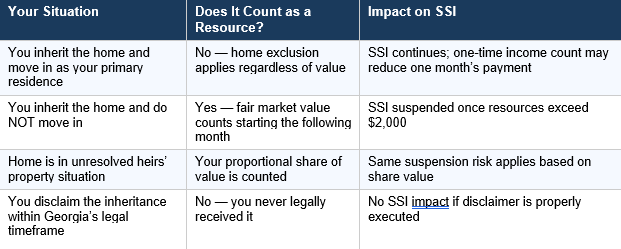
If you live in the inherited home as your principal place of residence, the home is excluded from SSI resources entirely under 20 CFR § 416.1212. A $300,000 Fulton County home inherited by an SSI recipient who moves in as their primary residence counts as zero dollars toward the $2,000 resource limit. This is the most beneficial outcome possible. The home is treated as income in the month you receive it — which may temporarily reduce your SSI payment for that one month — but from the following month forward, it is a completely excluded resource.
Scenario B: You Inherit the Home and Do NOT Move In
If you do not move in, the fair market value of the home counts as a resource starting the month after you receive it. Since virtually every Atlanta-area home — even in the most distressed neighborhoods — is worth far more than $2,000, your resources will exceed the SSI limit immediately. Your SSI will be suspended. It is not terminated permanently, but it will not resume until you bring your total resources back under $2,000 by selling, transferring, or otherwise disposing of the property.
Scenario C: Heirs’ Property Situations
If you are one of multiple heirs to a property that was never formally transferred and no will exists, you hold an undivided interest in that property. For SSI purposes, your proportional share of the property’s fair market value is counted as a resource. If your 1/4 share of a $320,000 Southwest Atlanta home is $80,000, that $80,000 far exceeds the $2,000 resource limit. Critically, the ownership interest in heirs’ property under Georgia’s intestate succession law vests at death — the SSI clock starts immediately, even without a deed transfer or formal probate proceeding.
Georgia probate does not pause the SSI clock. Even if the estate is in Fulton County Probate Court for 18 months, your entitlement date for SSI purposes is the date of death. The 30-day reporting obligation and the resource calculation both begin at that point.
Your Four Legal Options When You Inherit a House on SSI
The moment you inherit a house as an SSI recipient, you have legal pathways that can protect your benefits. These are not loopholes — they are federally recognized options. But every one of them requires timely action.
Option 1: Move Into the Home as Your Primary Residence
This is the simplest and most complete solution when it is physically and practically feasible. Moving in converts the home from a countable resource to an excluded resource — immediately and permanently, for as long as you live there. For SSI recipients who are currently renting, this can eliminate a housing cost entirely while preserving full SSI eligibility. In Atlanta’s rental market, this combination can be financially transformative.
The practical challenge for some Atlanta recipients: the inherited home may be in a different location, may need significant repairs before it is habitable, or may have multiple heirs with competing interests that complicate immediate occupancy. These complications are real but often solvable with the right support.
Option 2: Sell the Home and Spend Proceeds on Exempt Resources
If moving in is not feasible, selling the home and using the proceeds in specific ways that do not increase countable resources is a legitimate and commonly used path. Proceeds from the sale of a non-home resource do not face the same 3-month reinvestment requirement as proceeds from the sale of a primary residence — but they become countable cash unless directed to exempt uses.
Exempt uses of sale proceeds under SSI rules include: purchasing a primary residence (this is the most powerful option for Atlanta recipients — buy a home and move in, converting countable cash to an excluded home), purchasing a vehicle for transportation, paying off existing debt, paying for medical expenses, purchasing pre-paid burial arrangements, and making repairs to your primary residence.
ATL Home Help Solutions works with SSI recipients in exactly this situation — helping them sell inherited Atlanta property quickly and understand how to direct the proceeds in a way that protects SSI benefits rather than eliminates them.
Option 3: Disclaim the Inheritance
Under Georgia law (O.C.G.A. § 53-1-20), a beneficiary may disclaim an inheritance in writing, signed, filed with the probate court, within 9 months of the decedent’s death (or 9 months after the beneficiary turns 21). A properly executed disclaimer that is valid under Georgia law — filed before the beneficiary has accepted any benefit from or exercised any control over the property — may prevent it from being counted as an SSI resource.
The SSA’s position is that a valid disclaimer means the asset was never legally received, so there is no resource to count and no transfer penalty. This is fundamentally different from transferring an asset you already own.
Disclaimers are irrevocable. Once you disclaim an inheritance, it passes to the next beneficiary and you cannot receive it later. This option makes sense only when keeping the asset in any form would cause more harm to your benefits than the value of the asset itself. Consult a Georgia elder law attorney before disclaiming anything.
Option 4: Special Needs Trust
A properly structured Special Needs Trust (SNT) can hold assets for an SSI recipient without those assets counting toward the SSI resource limit. A self-settled SNT — funded with the recipient’s own inherited assets — must meet specific federal requirements and include a Medicaid payback provision. A third-party SNT, funded by someone other than the beneficiary, does not require a Medicaid payback.
If real property is transferred into a properly drafted SNT, it may not be counted as an SSI resource, allowing the recipient to benefit from the property — through rental income managed by the trust, for example — without losing benefits. This requires a Georgia-licensed elder law or special needs attorney to draft and administer correctly. The SSA policy manual on home and resource exclusions from SSI in POMS SI 01130.100 provides the detailed federal framework that governs how real property is evaluated in SSI resource determinations.
Atlanta-Specific Complications: Heirs’ Property, Probate, and the Fulton County Reality
Inheriting property in Metro Atlanta is not a simple transaction. The city’s housing history — particularly in historically Black communities where homeownership has been both a cornerstone of family wealth and a source of legal complexity — creates layers of complication that interact with SSI rules in ways most recipients and many professionals have never fully considered.
The Heirs’ Property Problem in Atlanta
Heirs’ property is one of the most prevalent property situations in Atlanta’s historically Black neighborhoods: Vine City, English Avenue, Pittsburgh, Mechanicsville, Bankhead, Cascade, Southwest Atlanta, and surrounding communities. It occurs when a property owner dies without a formal will and the property passes by intestate succession to multiple heirs who then never formally record the transfer. Multiple family members own undivided interests in the property without a formal deed.
For SSI recipients in this situation, there are three compounding problems. First, the ownership interest vests at death under Georgia law, starting the SSI clock immediately. Second, the recipient’s proportional share of the property value — even a small fraction — likely exceeds the $2,000 resource limit when applied to typical Atlanta market values. Third, the inability to make unilateral decisions about the property (because other heirs must agree) makes selling or resolving the situation significantly more complicated.
The Georgia Legal Aid guide to heirs’ property rights and inheritance provides plain-language explanations of how Georgia’s heirs’ property system works and what legal options are available to families in this situation. Resolving heirs’ property through the court system protects the family’s rights and opens the door to every program and legal option that requires clear title.
Atlanta Real Estate Values and the SSI Math
The Atlanta housing market makes every inherited property an immediate SSI resource issue of significant scale. There is no Atlanta-area home worth less than $2,000. Even the most distressed properties in the city typically carry values of $80,000 to $200,000 or more when land value is considered.
• South Fulton, East Point, College Park: inherited homes commonly worth $200,000 to $350,000
• Cascade Heights, Adamsville, Ben Hill: $250,000 to $400,000
• Historic in-town neighborhoods: $280,000 to $500,000+
• Even distressed or heirs’ property shares in Southwest Atlanta: $80,000 to $180,000
Every one of these values creates a resource that is 40 to 250 times the SSI resource limit. The urgency cannot be overstated.
The Georgia ABLE Account Option
Georgia’s ABLE program allows SSI recipients to hold up to $100,000 in an ABLE account without those funds affecting SSI eligibility. Proceeds from the sale of an inherited Atlanta home could potentially be deposited into a Georgia ABLE account up to the annual contribution limit of $18,000 per year from all contributors. This strategy works for partial protection of sale proceeds but cannot absorb the full value of a typical Atlanta home sale in a single year.
Fulton County Probate Court
Property passing by will in Georgia goes through the probate court in the county where the deceased resided. Fulton County Probate Court is located at 136 Pryor Street SW, Atlanta, GA 30303, and can be reached at (404) 730-5300. Probate can take 6 months to 2 years in complex cases. The SSI resource clock does not wait for probate to conclude.
What to Do Right Now If You’ve Inherited or Expect to Inherit a House in Atlanta
If you are an SSI recipient who has just inherited a house, or whose parent or family member is aging and owns Atlanta real estate, the following steps apply to you right now. Every day of delay narrows your options and increases your exposure.
1. Report to the SSA immediately: Call your local SSA field office or 1-800-772-1213 to report the inheritance. Do not wait until you have figured out what you’re going to do. Report first, plan second. Proactive reporting demonstrates good faith and protects you from fraud findings. The SSA field offices serving Fulton County can be located through the office finder at ssa.gov.
2. Do not make any decisions about the property before consulting a Georgia attorney: Do not sell it, transfer it, disclaim it, or sign anything before speaking with a Georgia-licensed elder law or special needs attorney. A single well-informed action can preserve your benefits. A single uninformed one can eliminate them. Atlanta Legal Aid Society at (404) 524-5811 provides free consultations for qualifying income levels.
3. Get a current market value assessment of the inherited property: You cannot make an informed decision without knowing what the property is actually worth. ATL Home Help Solutions can provide a fast, honest assessment of any Metro Atlanta inherited property’s current market value — no obligation, no pressure. This is the starting point for understanding your realistic options.
4. Evaluate the three primary pathways with professional guidance: Can you move in? If yes, this eliminates the resource problem immediately. Can you sell and use the proceeds to purchase a primary residence or another exempt resource? This converts one excluded resource type into another. Is a Special Needs Trust appropriate? An elder law attorney can evaluate your specific eligibility and the cost-benefit of this option.
5. Act within the resource window: SSI will suspend benefits once the inherited property counts as a resource exceeding $2,000. However, SSI recipients who sell or otherwise dispose of the excess resource and bring total resources back under $2,000 can requalify without a new application in most circumstances. The suspension ends when the resource is resolved. The sooner you act, the fewer months of suspended benefits you experience.
For the most current official guidance on how the SSA evaluates resources and the Georgia ABLE program for SSI recipients and disability beneficiaries, Georgia’s official ABLE program page provides enrollment information and current contribution limits.
The most common mistake Atlanta SSI recipients make: waiting. The combination of grief after losing a family member, fear of the SSI system, and the complexity of heirs’ property situations causes many recipients to do nothing for months. Every month of inaction is a month of suspended benefits and a growing overpayment demand. The earlier you act, the more options remain available.
Final Thoughts: The 30-Day Clock Is Already Running
Will inheriting a house affect your SSI benefits in Atlanta? The honest answer is: it will if you don’t act. But if you understand what the SSA requires, what options exist, and what the Atlanta housing market makes possible, an inherited home can become an opportunity rather than a crisis. Moving into it preserves both your benefits and your housing. Selling it strategically and purchasing a primary residence eliminates a housing cost and preserves your benefits simultaneously. The right answer for your specific situation depends on your circumstances, your family dynamics, and the specific property — not on a general article.
What every Atlanta SSI recipient reading this should take away is simple: report immediately, consult an attorney before acting, and get a real assessment of what the property is worth. Those three steps — done in the right order — protect you from the worst outcomes and open the door to the best ones.
Inherited Atlanta Property on SSI? The Next 30 Days Matter More Than You Know.
If you’re an SSI recipient in Atlanta who has just inherited a house — or you expect to — the next 30 days may be the most financially consequential period of your life. The decisions you make right now determine whether you keep your benefits, lose them temporarily, or face an SSA overpayment demand. I’m Gerald Harris, founder of ATL Home Help Solutions. I work with Atlanta families in exactly this situation. I can give you a fast, honest assessment of what the inherited property is worth, what your realistic options are, and how a sale — if that’s the right path — can be structured to protect your SSI benefits.
Don’t wait. Don’t guess. Call today.
📞 Call or Text: 404-913-7086 📧 Email: gerald@atlhomehelp.com
Visit ATL Home Help Solutions — Contact Gerald Harris — No pressure. No judgment. Just honest local guidance.