


Delinquent property taxes in Fulton County can quickly lead to liens and tax sale proceedings.
Homeowners should verify their balances early and explore payment options or relief programs promptly.
Acting early helps preserve property rights and reduces legal fees and total repayment costs.
Falling behind on property taxes in Fulton County is more common than you might think, and the consequences move faster than most homeowners expect. Interest starts stacking up, liens get recorded, and before long your home could be advertised for a tax sale. The good news is that you have options at every stage, and knowing the local rules gives you real power to act. This guide walks you through exactly how to check your balance, understand your choices, and take the right steps to protect your property before the situation gets worse.
Table of Contents
Understanding back property taxes and risks in Fulton County
What happens if you don’t pay: Tax sales, redemption, and saving your property
The real cost of delay: Hard truths and how to protect yourself
Key Takeaways
PointDetailsAct earlyThe sooner you address back taxes, the fewer penalties and risks you face.Check your official balanceUse Fulton County’s portal to know the exact amount owed and avoid surprises.Know your optionsResolve your debt by paying in full, applying for a payment plan, or seeking exemptions if eligible.Understand the tax sale processIf your property is sold, you have only 12 months to reclaim it with extra costs.
Understanding back property taxes and risks in Fulton County
To begin your path to resolution, it’s essential to understand what back property taxes actually mean and why addressing them quickly matters.
Delinquent property taxes are taxes that were billed but not paid by the due date. In Fulton County, tax bills go out in October each year. The payment deadline is December 20. Miss that date, and your taxes are officially delinquent.
Here is what happens after that deadline, step by step:
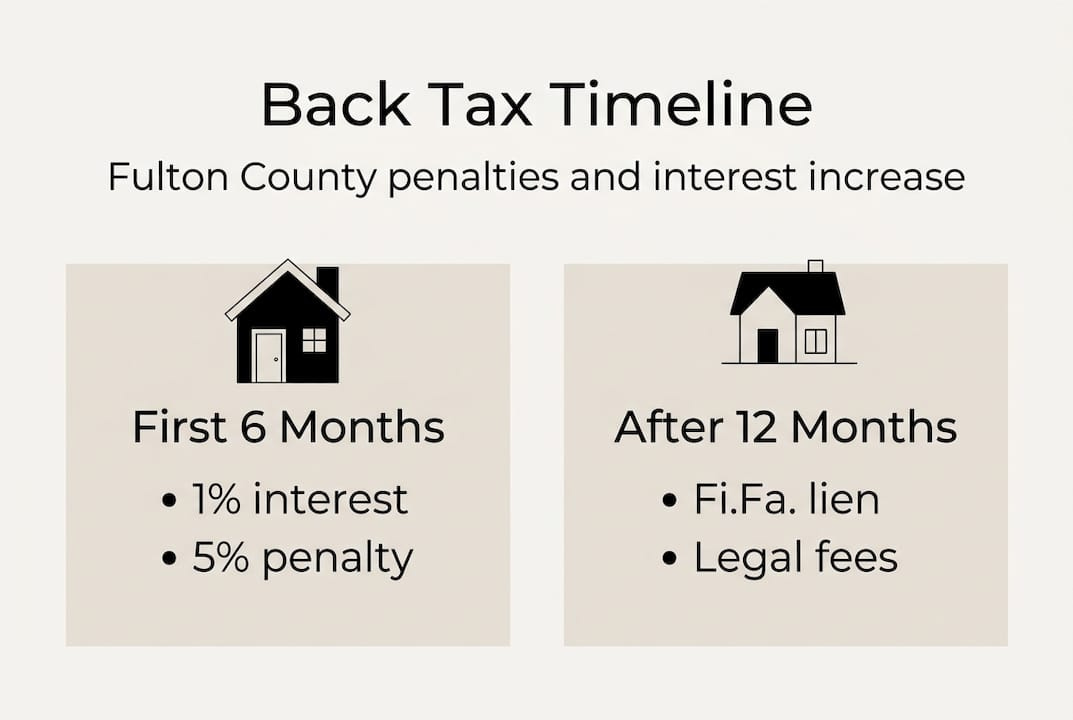
StageWhat happensDecember 21 onward1% monthly interest begins accruingFollowing months5% penalty added to the unpaid balanceSpring/SummerFi.Fa. lien recorded against your propertyLate summer/fallProperty advertised for tax sale in local newspaperAuction dateProperty sold to highest bidder if taxes remain unpaid
A Fi.Fa. (short for fieri facias) is a legal document that acts as a lien on your property. It means the county has a legal claim against your home until the debt is paid. Once recorded, it can affect your ability to sell or refinance. You can review the delinquent tax list to see if your property appears there.
According to the Fulton County tax timeline, bills go out in October, taxes are due December 20, interest runs at 1% per month, a Fi.Fa. lien is recorded, the property gets advertised, and it goes to auction if still unpaid.
One common misconception is that you have a long grace period after the due date. You don’t. Interest starts the very next day. Another mistake homeowners make is assuming that foreclosure notices only apply to mortgage debt. Tax-based actions are separate and can move quickly even if your mortgage is current.
The Georgia DOR property tax FAQ confirms that county tax commissioners manage collections and have authority to pursue liens and sales. This is not a process that pauses on its own.
Key reminder: A tax lien can cloud your title, making it nearly impossible to sell or refinance your home until the debt is cleared. Don’t wait for a notice in the mail to take action.
Check your delinquent balance and gather documents
Now that the basics and risks are clear, the next step is to understand your exact situation by getting accurate numbers and paperwork.
To check your delinquent balance, visit the official Fulton County Tax Portal. You can search by your parcel ID number or your property address. The portal shows your current balance broken down by year, which matters because each delinquent year carries its own interest and fees.
Here is what makes up your total balance:
Original tax amount billed for the year
Monthly interest at 1% from December 20
5% penalty added after delinquency
Fi.Fa. recording fees once the lien is filed
Attorney or legal costs if the account moves to legal collection
Those last two items surprise many homeowners. By the time legal fees are added, a $3,000 tax bill can grow to $4,500 or more. That’s why acting early matters so much.
Pro Tip: Screenshot or print your balance from the portal before you call the Tax Commissioner’s office. Having the exact figures in front of you makes the conversation faster and reduces confusion.
Here is a quick example of how a balance grows:
Starting tax debtAfter 6 monthsAfter 12 months (with Fi.Fa.)$2,500~$2,775~$3,200+$5,000~$5,550~$6,400+
These are estimates, but they show how quickly the numbers move. You can also use the property tax lookup tool to verify ownership records and confirm which years are unpaid.
Gather these documents before you contact the Tax Commissioner:
Your most recent tax bill or notice
Any Fi.Fa. or lien notices you’ve received
Prior year statements showing what was paid
Any correspondence from the Tax Commissioner’s office or attorneys
Your property’s parcel ID number
Having everything organized puts you in a much stronger position when you call or visit in person.

Your options: Payment, payment plans, and relief programs
Once you know your exact balance, it’s time to choose the best way to bring your taxes current.
You have three main paths: full payment, a payment plan, or applying for an exemption or deferral. Each has trade-offs.
Full payment - is the cleanest option. Pay the full payoff amount online through the Fulton County Tax Portal, by mail with a certified check, or in person at the Tax Commissioner’s office. Once paid, the Fi.Fa. lien is released and your title is cleared. You can also pay online and get step-by-step instructions for the smoothest process.
Payment plans - are available but limited. The Fulton County Tax Commissioner offers installment agreements in certain circumstances, but they are not automatic. You must contact the office directly to ask and qualify. Plans typically cover one tax year at a time, not multiple years at once. Interest continues to accrue during the plan, so the sooner you start, the less you pay overall.
OptionBest forKey limitation - Full paymentAnyone who can access fundsRequires lump sumPayment planOwners with steady incomeNot available for all casesHomestead exemptionOwner-occupied primary homesReduces future bills, not past debtSenior/low-income deferralQualifying residentsMust apply and meet income limits
Homestead exemptions -lower your assessed value and reduce future tax bills. They don’t erase what you already owe. If you haven’t applied yet, visit fultonassessor.org to check your eligibility. Seniors and low-income residents may qualify for additional deferrals that pause new tax obligations while you catch up.
Pro Tip: Call the Tax Commissioner’s office before your property gets advertised for sale. At that stage, your delinquent tax options narrow significantly and legal fees increase. Early contact keeps more doors open.
What happens if you don’t pay: Tax sales, redemption, and saving your property
Even with the right steps, missing payments can lead quickly to serious consequences, so it’s important to understand what happens if you don’t act in time.
Once a property is advertised, it enters the tax sale process. Here is how it unfolds:
Advertisement: The county publishes delinquent properties in a local newspaper for four consecutive weeks before the sale.
Auction date: Sales typically happen at the county courthouse. The property goes to the highest bidder.
Deed transfer: The winning bidder receives a tax deed, giving them rights to the property.
Redemption window opens: You have 12 months from the sale date to reclaim your property.
The 12-month redemption period is governed by O.C.G.A. § 48-4-40. To redeem, you must pay the winning bid amount plus a 20% premium in one lump sum. No partial payments are accepted.
Here is why that matters. If your property sold at auction for $40,000, you would need to pay $48,000 within the first year to get it back. If you wait until year two (if allowed), additional premiums stack on top. The tax deed law explains how these premiums are calculated under Georgia statute.
Urgent reminder: Once the redemption period expires, you lose the right to reclaim your property entirely. At that point, only legal action or negotiation with the new deed holder may help, and neither is guaranteed.
If your property is close to a sale date or has already been sold, contact a real estate attorney in Georgia immediately. Time is the most valuable thing you have at this stage. Review the tax lien process to understand your full rights before that window closes.
The real cost of delay: Hard truths and how to protect yourself
Understanding the technical process is only half the battle. Let’s talk about what most guides miss.
We’ve seen homeowners wait because they believed a payment plan would save them, only to find out they didn’t qualify. We’ve seen others assume a homestead exemption would wipe out old debt. It won’t. These are expensive assumptions.
Here is the uncomfortable truth: every month you wait, the math gets worse. Interest, penalties, and legal fees compound in ways that feel abstract until you see the actual payoff number. A $4,000 debt ignored for two years can easily become a $6,500 obligation with attorney fees attached.
Sometimes, the smartest move is to sell the property before it reaches a tax sale. If you have equity, a sale lets you pay off the debt, keep the remaining proceeds, and walk away with something. Entering the redemption process after a sale means paying a 20% premium on top of whatever the auction price was. That premium often wipes out any equity you had left.
Early action reduces costs at every stage, and that’s not just advice. It’s the pattern we see repeatedly with Fulton County homeowners who reach out early versus those who wait until the sale notice arrives. Direct engagement with the Tax Commissioner’s office, even when the situation feels embarrassing or overwhelming, preserves your options and your equity. Don’t let pride or fear cost you your home.
Get help settling back property taxes in Fulton County
Dealing with back property taxes is stressful, but you don’t have to figure it out alone. At ATL Home Help Solutions, we provide free local guidance to Fulton County homeowners at every stage of the process.

Whether you need to understand your property tax assistance options, want to explore foreclosure prevention tips before things escalate, or simply need help using the tax lookup support tools to verify your balance and parcel details, we’re here to walk you through it. Our resources are built specifically for Atlanta and Fulton County homeowners facing real pressure. Reach out today and take the first step toward protecting your home and your future.
Frequently asked questions
Can I get my property back after a Fulton County tax sale?
Yes, you have a 12-month redemption period under O.C.G.A. § 48-4-40 to reclaim your property by paying the winning bid plus a 20% premium, but the full amount must be paid in one lump sum with no partial payments accepted.
Are payment plans always available for back taxes in Fulton County?
Not always. Installment agreements are offered in certain circumstances and must be arranged directly with the Tax Commissioner’s office, so contact them early before your account moves to legal status.
What interest and penalties apply to delinquent property taxes?
Interest accrues at 1% per month starting December 20, plus a 5% penalty, and additional Fi.Fa. recording fees and attorney costs can be added once the account moves into legal collection.
Do homestead exemptions erase old tax debts?
No. Homestead exemptions reduce your assessed value going forward and lower future bills, but they do not eliminate existing delinquent balances unless a specific deferral program applies to your situation.