


Quick Answer: Whether you should fix your house or sell as-is in Atlanta depends on four factors: your equity position, your timeline, your available capital, and your local market. In most distressed or time-sensitive situations, selling as-is to a cash buyer in Atlanta produces a better net outcome than spending $30,000–$60,000 on repairs with uncertain ROI. But in high-demand neighborhoods with strong comps, targeted repairs can meaningfully increase your net proceeds. The decision requires real numbers — not guesses.
You’re standing in your Atlanta home looking at the cracked drywall, the bathroom tile you never replaced, the kitchen that peaked somewhere around 2003 — and you’re trying to decide whether to spend $40,000 fixing it before selling or just list it as-is and let the market decide. The answer isn’t as simple as most people online make it sound. And in Atlanta’s specific market, the numbers often tell a very different story than you’d expect.
This is one of the most common questions I hear as a real estate consultant working with Atlanta and Fulton County homeowners. Should I fix my house or sell as is? The honest answer is: it depends entirely on your specific situation, your neighborhood, and what the real numbers show. The wrong answer — made based on assumption rather than calculation — can cost you $20,000 to $50,000 in either direction.
Metro Atlanta is a highly segmented market. The right decision in Buckhead is often the wrong decision in East Point. The renovation ROI calculation in Sandy Springs is entirely different from the one in Cascade Heights or College Park. This guide gives you the honest, locally grounded framework you need to make the right call for your specific property.
Why This Decision Is Different in Atlanta Than Anywhere Else
Atlanta is one of the most geographically and economically segmented real estate markets in the Southeast. The city covers more than 130 square miles, spans multiple counties, and contains neighborhoods with dramatically different buyer profiles, price ceilings, and renovation expectations. What works in one zip code is often the wrong strategy three miles away.
Neighborhoods Where Renovation ROI Is Strongest
In Buckhead, Virginia-Highland, Morningside, Inman Park, and Candler Park, buyers are high-income and expect move-in ready condition. A fully renovated home commands a meaningful premium over an as-is counterpart, and targeted renovation ROI can be strong. The same applies in Sandy Springs, Dunwoody, and Alpharetta, where the buyer profile expects a finished product. In these markets, a thoughtful renovation done correctly and completed on time has a real financial argument.
Neighborhoods Where As-Is Sales Often Make More Financial Sense
In East Point, College Park, Southwest Atlanta, Cascade, Mechanicsville, Lakewood, and South Fulton communities, the buyer pool includes a significant proportion of investors and first-time buyers who are willing and able to take on work. In these markets, renovation costs frequently cannot be fully recovered in the sale price — meaning the homeowner spends $45,000 on renovation and adds $30,000 in sale price. The as-is sale, often at a smaller discount than expected, produces a better net result.
The Investor Activity Factor
Atlanta ranks among the top metros nationally for investor home purchases. Cash buyers, fix-and-flip companies, and institutional investors are active in virtually every Atlanta zip code. This investor activity creates a real, functioning market for as-is properties — one that does not exist at the same depth in smaller markets. In Atlanta, an as-is home in good location has genuine buyer competition. The discount homeowners expect to accept is frequently smaller than they fear.
The Carry Cost Reality
Atlanta homeowners who decide to renovate before selling are looking at 3 to 9 months of additional ownership costs while construction is completed and the home is listed, shown, and under contract. In a market with elevated interest rates, those carry costs — mortgage, taxes, insurance, utilities — typically run $1,800 to $3,500 per month on a median Atlanta home. Six months of carry adds $10,800 to $21,000 to the real cost of renovation, a figure rarely included in casual renovation ROI discussions.
The Honest Math Behind Renovating Before You Sell in Atlanta
Most renovation advice homeowners find online overstates renovation ROI. The actual numbers in Atlanta’s market require a more disciplined calculation — one that accounts for contractor costs that have risen 25 to 40 percent since 2020, realistic timelines, and the full burden of carry costs.
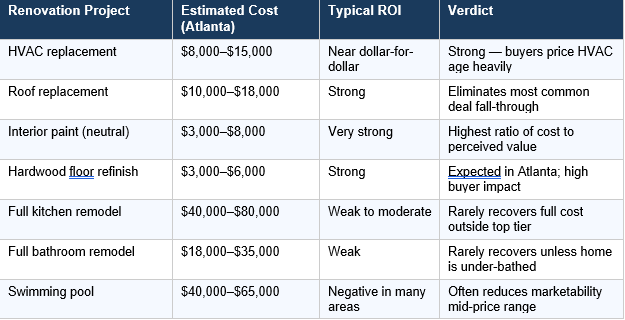
Start with your home’s current as-is value based on real comparable sales in your specific neighborhood within the past 90 days — not Zillow’s estimate. Add the post-renovation value based on comps for fully renovated homes in that same neighborhood. Subtract the renovation cost (get three licensed contractor bids and add 25 percent for overrun). Subtract carry costs for the renovation and listing period. Subtract selling costs including agent commission and closing costs. What remains is the net gain from renovation — compare it to simply selling as-is today.
The renovation budget creep problem: Atlanta construction almost always costs more and takes longer than initial estimates. A $35,000 renovation estimate frequently becomes $48,000 when the contractor opens walls. A 90-day timeline becomes five months. Budget for 20–30% overrun and 30–50% schedule delay in every ROI projection.
When Selling As-Is in Atlanta Makes the Most Financial Sense
For a significant majority of Atlanta homeowners in the situations described below, selling as-is produces a better net outcome than renovation. This isn’t a universal rule — but it is the right answer more often than most homeowners expect when they run the real numbers.
Situation 1: You Need to Sell Quickly
Timeline pressure from divorce, job relocation, estate settlement, financial distress, foreclosure, or delinquent property taxes changes the calculation entirely. Renovation timelines in Atlanta run 3 to 9 months from contractor hire to listing-ready condition. Carrying costs for six additional months on a $280,000 Atlanta home run $14,000 to $21,000. A cash as-is sale can close in 7 to 21 days. In most cases, the modest price discount of an as-is sale is smaller than the sum of avoided carry costs and renovation expenses.
Situation 2: The Repairs Are Structural, Mechanical, or Code-Related
Foundation issues, major roof failures, knob-and-tube wiring, galvanized plumbing, unpermitted additions, and failing HVAC systems fall into a different category than cosmetic updates. These repairs are expensive, time-consuming, and frequently reveal additional problems when work begins. Investors who buy properties as-is with known structural and mechanical issues price them precisely and close quickly. The alternative — a traditional MLS listing with disclosed structural issues — is slow, complicated, and frequently terminates in deal fall-through after the inspection period.
Situation 3: Deferred Maintenance Across Multiple Systems
When HVAC, roof, plumbing, electrical, and cosmetic updates all need attention simultaneously, the total renovation budget frequently reaches $60,000 to $100,000 or more. In most non-premium Atlanta zip codes, this budget approaches or exceeds the realistic value uplift from full renovation. At this point, the as-is sale is not a concession — it is the financially superior choice by a meaningful margin.
Situation 4: Liens, Delinquent Taxes, or Title Complications
A home with delinquent property taxes, an active Fi. Fa. lien, a mechanic’s lien from a prior contractor, or a complex heirs’ property title situation is not a strong renovation candidate. These issues must be resolved at closing regardless of the sale method. An as-is cash buyer — who does not require lender financing — can close on a property with title complications that would prevent a traditional financed buyer from completing the transaction at all. The as-is sale resolves everything cleanly in a single closing.
Situation 5: You Don’t Have the Renovation Capital
Renovating without the right budget produces worse outcomes than not renovating at all. Half-finished work, visible cost-cutting (cheap fixtures, inconsistent finishes, mismatched flooring), and rushed timelines signal to Atlanta buyers that the renovation was done for sale rather than for quality — and they discount accordingly, sometimes more harshly than they would have discounted the original as-is condition.
The as-is market in Atlanta is deep. Unlike smaller markets where as-is homes sit for months, Atlanta has a large, active ecosystem of cash buyers, investors, and institutional purchasers who buy as-is properties across all price ranges and conditions. The price discount for as-is in Atlanta is often smaller than homeowners expect.
When Renovating Before You Sell Actually Pays Off in Atlanta
Renovation can absolutely increase your net proceeds — but only under specific conditions that are less common than most homeowners assume. Here is when renovation has a genuine financial argument in Atlanta’s market.
The Conditions That Favor Renovation
• High-demand, move-in ready market: Homes in Buckhead, Virginia-Highland, Decatur, Morningside, Inman Park, and similar neighborhoods sell at significant premiums for fully renovated turnkey condition. Buyers here pay a premium for the completed product.
• Small gap between as-is and market ceiling: If your as-is value is $340,000 and renovated comps close at $420,000, a $45,000 targeted renovation has a real margin to work with. When the gap is $20,000 and renovation costs $35,000, the math fails.
• Cosmetic-only needs: Paint, flooring, landscaping, and fixture updates. Defined scope, short timeline, predictable cost. These projects consistently generate positive ROI when the market supports them.
• No timeline pressure and available cash: Renovation ROI requires patience and financial staying power. Without both, the risk of overrun consuming projected gains is high.
• The home photographs poorly: In Atlanta’s digitally-driven market, online photos are the first showing. A home that photographs poorly due to dated finishes limits its buyer pool. Strategic cosmetic renovation plus professional photography can expand buyer interest meaningfully.
The specific renovations that consistently generate ROI in Atlanta when market conditions support renovation: HVAC replacement ($8,000–$15,000), roof replacement ($10,000–$18,000), fresh neutral paint throughout ($3,000–$8,000), refinished hardwood floors ($3,000–$6,000), and updated light fixtures and hardware ($1,500–$3,000). These projects are defined in scope, short in timeline, and consistently improve buyer perception in Atlanta’s market. A pre-listing market analysis from a knowledgeable Atlanta real estate consultant can validate whether your neighborhood supports the upside. Check your current assessed value and neighborhood comps through the Fulton County Board of Assessors property value tool before committing to any renovation budget.
How to Calculate Your Real Numbers Before Deciding
The single most common mistake Atlanta homeowners make in this decision is choosing a path based on emotion or assumption rather than actual numbers. Here is a straightforward five-step framework to calculate what each option actually puts in your pocket.
1. Get a Real As-Is Value: Not Zillow. Not Redfin. A current, realistic as-is value from someone who has sold homes in your specific Atlanta neighborhood in the past 90 days. An accurate as-is value is the foundation of every calculation that follows — an inflated estimate in either direction produces a wrong answer.
2. Get Renovation Bids (Not Estimates): Contact at least three licensed Georgia contractors for written bids on the specific scope of work you are considering. Verify Georgia contractor licenses through the Secretary of State’s licensing board. Add 25 percent for overrun — this is not pessimism, it reflects what Atlanta construction data consistently shows.
3. Calculate Carry Costs: Mortgage payment multiplied by estimated months until closing after renovation. Add prorated property taxes, homeowner’s insurance, utilities, and HOA if applicable. In Atlanta, this typically runs $1,800 to $3,500 per month for a median-priced home.
4. Research Post-Renovation Comparable Sales: Find three to five homes in your specific neighborhood that sold in fully renovated condition within the past 90 days. The gap between those prices and current as-is comps for your property is the realistic value uplift ceiling. The CFPB’s home selling and value guide is a reliable starting point for understanding how home value is assessed before a sale.
5. Run the Side-by-Side Calculation: As-Is Path: as-is sale price minus selling costs (8–10% total) equals net proceeds. Renovation Path: post-renovation price minus renovation cost minus carry cost minus selling costs equals net proceeds. Compare both figures honestly — then factor in time, stress, and risk.
The risk factor: The renovation path carries real risk — contractor delays, cost overruns, market shifts during the renovation period, and deal fall-through on inspection of renovation quality. The as-is path with a cash buyer carries almost no execution risk once a contract is signed. Factor this into your comparison.
What Atlanta Cash Buyers Actually Offer and How the Process Works
Many Atlanta homeowners are skeptical of as-is cash sales because they’ve heard about lowball offers. Understanding how the market actually prices as-is properties in Atlanta puts you in a much stronger position to evaluate any offer you receive.
Who Buys As-Is Homes in Atlanta
• Individual real estate investors looking for rental or fix-and-flip opportunities
• Fix-and-flip companies operating at scale across Metro Atlanta
• iBuyers (Opendoor, Offerpad) operating in select Atlanta zip codes
• Direct cash buyers who want a specific property for personal use or investment
How Offers Are Priced
Cash buyers typically start with the After Repair Value (ARV) of the home — what it will be worth after they renovate. They subtract their estimated renovation cost, their carrying costs during renovation, and their target profit margin. The “70% rule” (offer = 70% of ARV minus renovation cost) is commonly used as a baseline, though competition among investors in Atlanta has pushed offers higher in many active neighborhoods. A homeowner who understands this math can evaluate whether an offer is reasonable or not.
The Offer Gap in Atlanta’s Market
In high-demand areas — East Atlanta Village, Kirkwood, Reynoldstown, Grant Park — as-is offers frequently come in at 85 to 93 percent of as-is market value because investor competition is high. In slower-moving areas, offers may come in at 70 to 80 percent of as-is value. The “discount” homeowners accept for an as-is sale is often smaller than the total cost of renovating — making as-is the financially superior choice even when the offer appears below asking.
What the As-Is Closing Process Looks Like
• No appraisal contingency — cash buyers don’t require lender approval
• No repair requests after inspection — sold as-is means exactly that
• Closing in 7 to 21 days in most cases
• Delinquent taxes, liens, and outstanding mortgage balance paid at closing from proceeds
• No agent commission in many direct sale situations
Warning Signs of a Predatory Offer
• Offer significantly below market even accounting for as-is condition — know your as-is value before evaluating any offer
• Pressure to sign quickly with no time to get a second opinion or consult an advisor
• Requests for exclusive option agreements that limit your ability to evaluate competing offers
• Verbal offers without written documentation — any legitimate buyer will put their offer in writing
For a clear understanding of what any home sale contract should contain and what your rights are as a Georgia seller, review the Georgia Real Estate Commission’s consumer protection guide before signing any agreement.
Making the Final Decision — A Framework for Atlanta Homeowners
Here is a direct, honest decision framework based on real Atlanta market conditions. Apply it to your specific situation.
Sell As-Is If: You need to close in under 60 days for any reason. The total renovation budget exceeds $30,000 or involves multiple systems. The property has structural, electrical, plumbing, or foundation issues. There are liens, delinquent taxes, title complications, or heirs’ property issues. You don’t have renovation capital without taking on debt. You are facing foreclosure, a tax sale deadline, or any other time-driven situation. The home is in a neighborhood where renovation ROI historically does not recover full renovation cost.
Renovate Before Selling If: Your neighborhood shows strong comps for fully renovated homes at $80,000 or more above your as-is value. The repairs are cosmetic only and can be completed in under 60 days. You have renovation capital available without financial distress. You have no timeline pressure and can absorb 4 to 8 months of additional carry cost. Your post-renovation net proceeds clearly exceed your as-is net proceeds by more than 15 percent after all costs are included.
For the majority of homeowners asking the question — should I fix my house or sell as is — selling as-is is the right answer once all real costs of renovation are honestly calculated. The exceptions are real, but they require the right market conditions, the right capital, and the right timeline to work. Neither path should be chosen based on what a neighbor did or what a general article online recommends. The answer lives in your specific property’s numbers.
Many Atlanta homeowners — particularly long-term owners in neighborhoods experiencing rapid appreciation — feel a sense of obligation to present a “perfect” home. That instinct is understandable but frequently costly. A well-priced as-is home in Atlanta moves quickly. The market does not reward perfection the way homeowners expect it to. What it rewards is accurate pricing and a clean transaction.
Final Thoughts: The Right Answer Is in Your Numbers, Not Online
There is no universal answer to whether you should fix your house or sell it as-is in Atlanta. There is only the right answer for your specific property, your specific neighborhood, your specific timeline, and your specific financial position. Any article — including this one — that tells you otherwise is oversimplifying a decision that deserves real attention.
What this guide gives you is the framework to find that answer: the market context, the real ROI calculation, the conditions that favor each path, and the questions to ask before you commit. Use it to have a better conversation with whoever helps you make this decision.
Not Sure Which Path Is Right for Your Atlanta Property? Let’s Run the Real Numbers.
If you’re sitting in your Atlanta home right now trying to decide whether to fix it up or sell it as-is — don’t make that decision without real numbers. I’m Gerald Harris, founder of ATL Home Help Solutions, and this is exactly the kind of decision I help homeowners think through every day. I’ll give you an honest assessment of your as-is value, a realistic renovation ROI projection based on your specific neighborhood and condition, and a clear-eyed comparison of what each path actually puts in your pocket — not what you hope it will. No pressure to sell. No pressure to renovate. Just the honest math and honest guidance you need to make the right call.
The right decision starts with the right information.
📞 Call or Text: 404-913-7086 📧 Email: gerald@atlhomehelp.com
Visit ATL Home Help Solutions — Contact Gerald Harris — No pressure. No judgment. Just honest local guidance.